
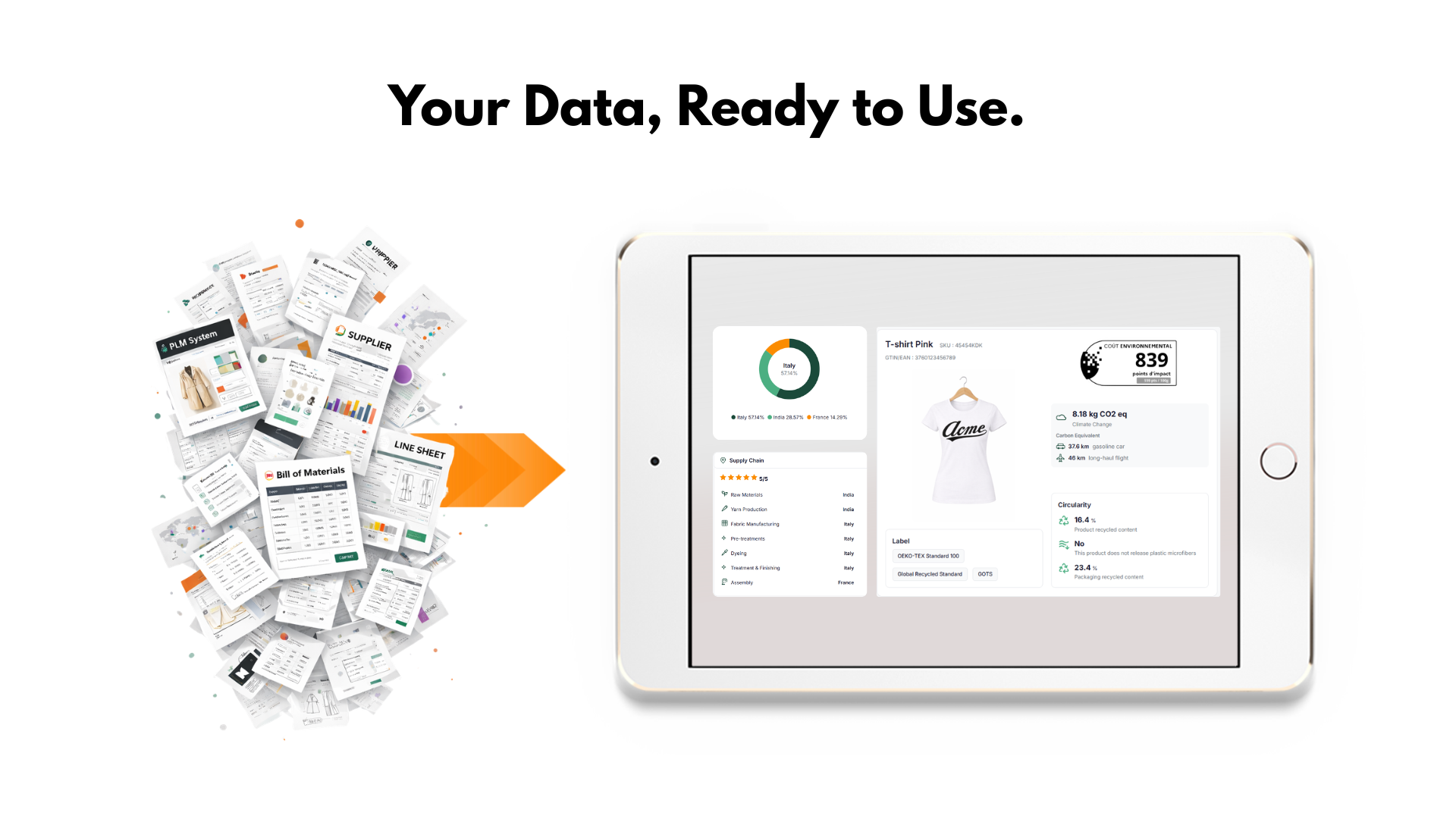
From existing product data to a structured Data Blueprint, AI mapping prepares everything needed for LCA, DPP and French Ecoscore
Fashion brands that invest in environmental data infrastructure are not just preparing for regulation. They are building a competitive advantage: the ability to make faster product decisions, communicate with credibility, and lead on sustainability rather than follow
We sat down with Mathilde Mével, Head of Product at Peftrust, to understand how the platform’s new AI-powered data mapping feature works in practice and what it means for sustainability and product teams trying to move faster.
Getting to Calculation: The Data Foundation That Changes Everything
Most sustainability managers already understand LCA methodology. What they want is to spend less time preparing data and more time using it. Generating an environmental score, whether for the French affichage environnemental, a DPP-compatible EU submission, or an internal eco-design roadmap, requires structured product data: material composition, component weights, accessory details, and consistent measurement units.
Getting that data ready has traditionally been the slow part. It sits across departments and systems, held by different people in different formats. Pulling it together takes time that teams would rather spend on strategy and action.
There is a principle worth keeping in mind here: LCAs don’t reward more data, they reward the right data. Brands do not need a perfect dataset to get started. They need a structured one.
That is exactly what Peftrust’s new AI data mapping feature delivers.
"Once teams have clean, structured data, everything moves quickly. The calculation itself is fast. The analysis is fast. The decisions become possible. Our goal was to make that first step as easy as it should be."
Mathilde
AI-Supported Data Mapping: Start From Where You Are
Peftrust has always offered ways to structure and organise brand data within the platform. What the new AI layer changes is the starting point: brands can now begin with the data they actually have, rather than spending weeks preparing it first.
What Brands Get
Brands can upload the product file they already have and quickly obtain structured, ready-to-use product data within the Peftrust platform.
Where information is incomplete, results draw on Peftrust’s validated internal benchmarks or brand-specific assumptions. The outputs remain transparent and fully traceable.
The positioning is deliberate: AI-supported. LCA engineer validated.
LCAS DON'T REWARD MORE DATA. THEY REWARD THE RIGHT DATA. THE GOAL IS SIMPLE: GET TEAMS OUT OF DATA PREP AND INTO DECISIONS.
The Output: A Data Blueprint
Think of it like building a house. Before you choose the paint colour or hang the front door, the foundations have to be right. The Digital Product Passport, the French Ecoscore, and the environmental disclosures brands share with the world: these are the visible layer. What the Data Blueprint does is ensure everything underneath is solid, structured, and documented before anything is built on top of it.
Like an architectural plan, it does not just describe what exists. It sets out exactly what was decided, why, and by whom. Every assumption recorded. Every source referenced. Engineers sign off before anything moves forward.
Energy Redirected, Time Reclaimed
What used to require coordination across sustainability, product, sourcing, and sometimes IT, over weeks or months, now happens in a fraction of the time. Teams that previously spent their energy consolidating and cleaning data can redirect that energy toward analysis, decision-making, and action.
"The goal was never to automate for automation's sake. It was to give sustainability teams back the time to do the work that actually matters to them."
Mathilde
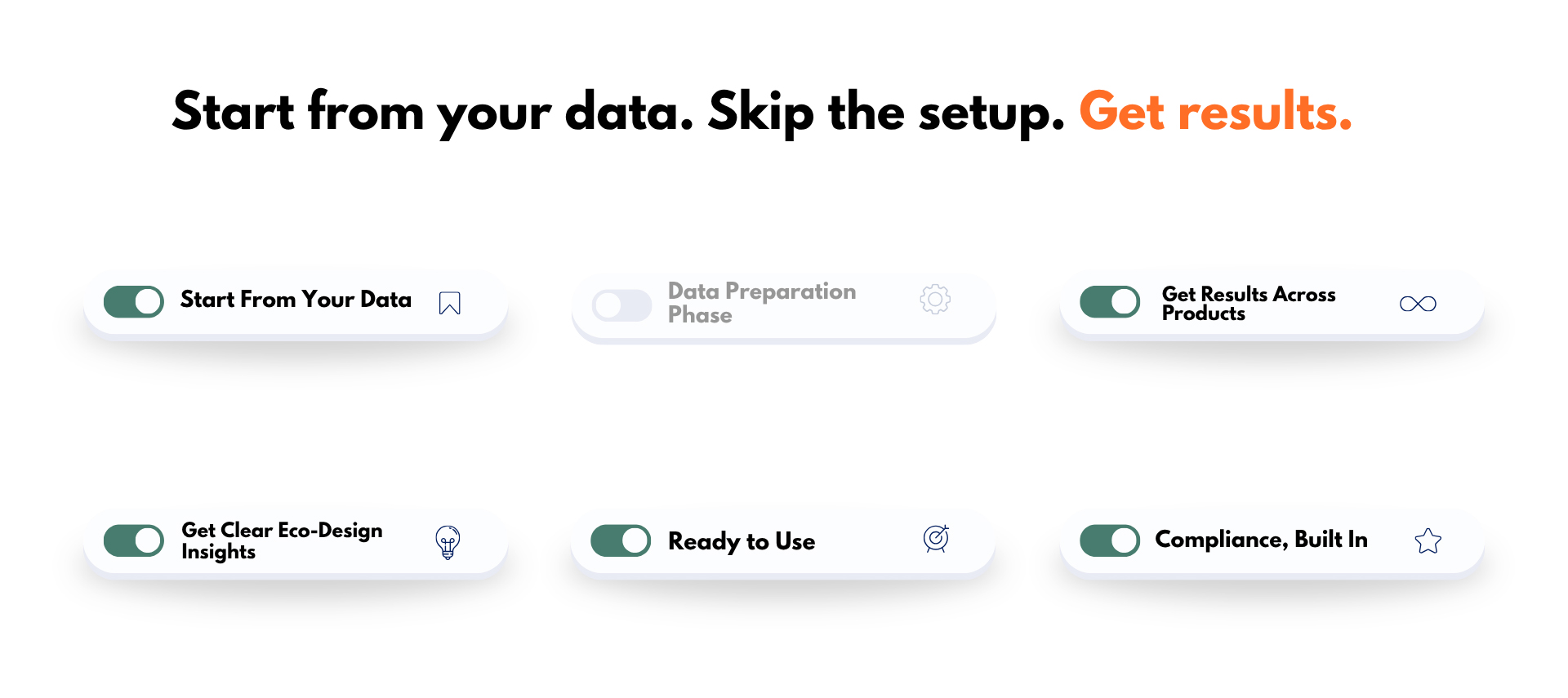
Stop Rebuilding. Start Scaling.
A Regulatory Window That Rewards Early Movers
The EU’s ESPR regulation and Digital Product Passport framework are creating a new baseline for what fashion brands need to demonstrate about their products. The DPP for textiles will require product-level environmental data, including LCA-based scores, material traceability, and repair and end-of-life information, to be accessible digitally for every product placed on the EU market.
Brands that have already been building toward the French affichage environnemental, which has beenlive on products in the French market since Oct 2025, are in a strong position. The methodology is closely aligned with PEF, meaning their existing data infrastructure transfers directly. Getting DPP-ready is not starting from scratch. For many brands, it is completing a journey already underway.
"Brands that have invested in good data practices are going to find this transition much smoother than they expect. And those that start now still have time to build a real advantage."
Mathilde
The Platform That Grows With You
Peftrust’s roadmap is built around a single ambition: a guided environment where sustainability teams have everything they need in one place, from the first data upload to the final disclosure.
“We want sustainability teams to feel like they have a partner that understands the complexity of what they are doing,” says Mathilde. “Not a tool that creates more work, but one that makes the right decisions obvious.”
Key Takeaways
- Start with the data you already have. Peftrust’s AI mapping handles the structuring and produces an audit-ready Data Blueprint.
- Trust the gaps to be filled intelligently, using LCA-validated benchmarks or your own assumptions, never arbitrary values.
- Know that every score follows EU PEF methodology and every assumption is documented, so disclosures and audits are straightforward.
- If you are already working toward the French affichage environnemental, you are closer to DPP-ready than you think. Your data infrastructure transfers directly.
- Reclaim the months your team used to spend on data preparation and redirect that time toward decisions that actually move the needle.
