
Publish your French Ecoscore. Official and Ready for Every SKU.
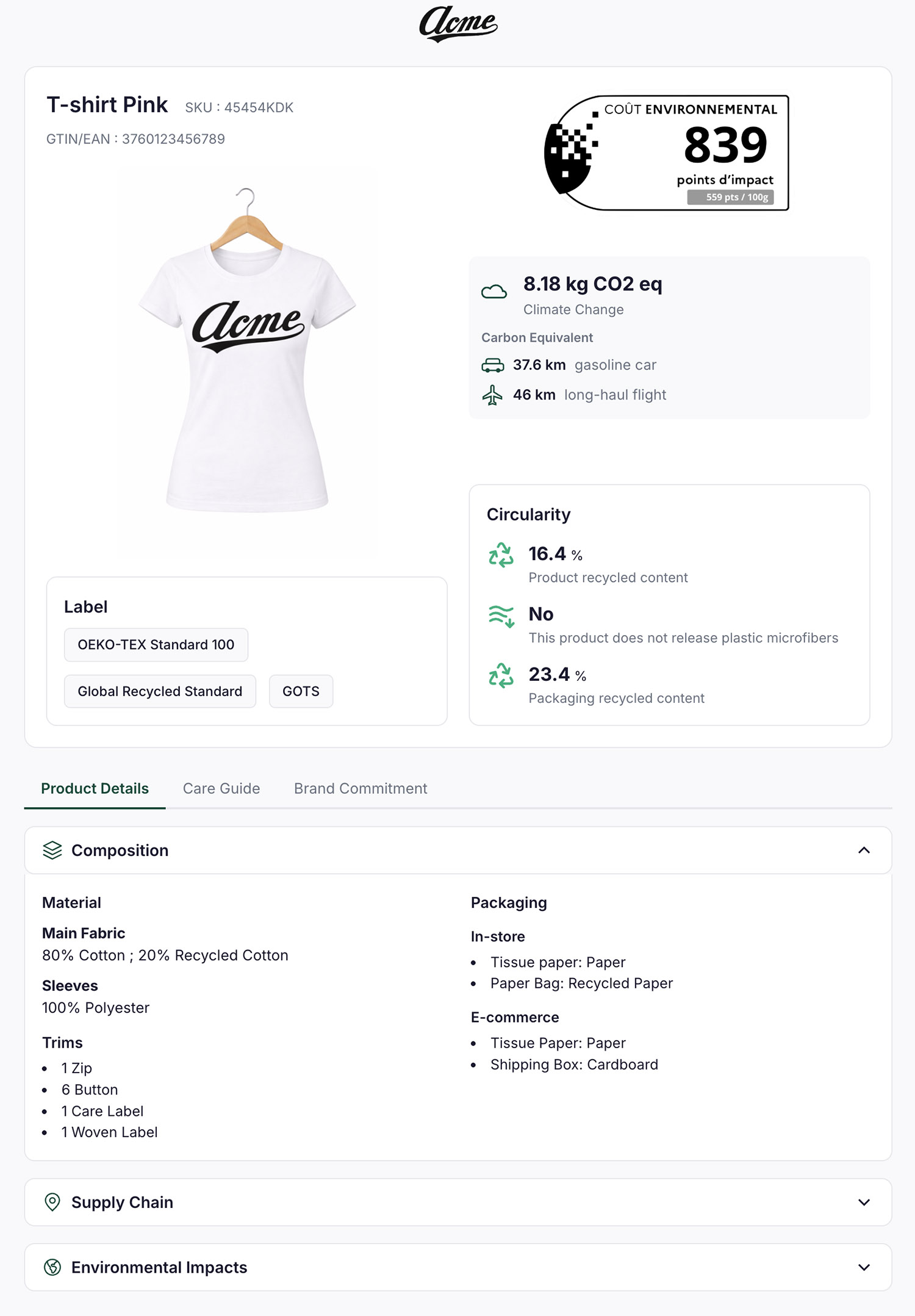
Turn your product data into a consumer-facing page with the France’s official environmental score — also called the French ecoscore — plus clear impact breakdowns and supply chain visibility. Ready for QR codes, e-commerce, and in-store use.
LIVE EXAMPLE
One URL per SKU · updates automatically
REGULATORY DEADLINE · OCTOBER 2026
If you don’t declare, a third party can publish a score for your products without your input — using conservative default data. Declaring first means your own data is used.
WHAT THE PAGE LOOKS LIKE
The score, the impacts, the supply chain, all in one place.
- Official Ecobalyse score, ready to publish
- Climate and environmental impacts, translated into clear metrics
- Product and circularity information customers expect
- Structured product data, consistent across channels
- Supply chain steps, made visible
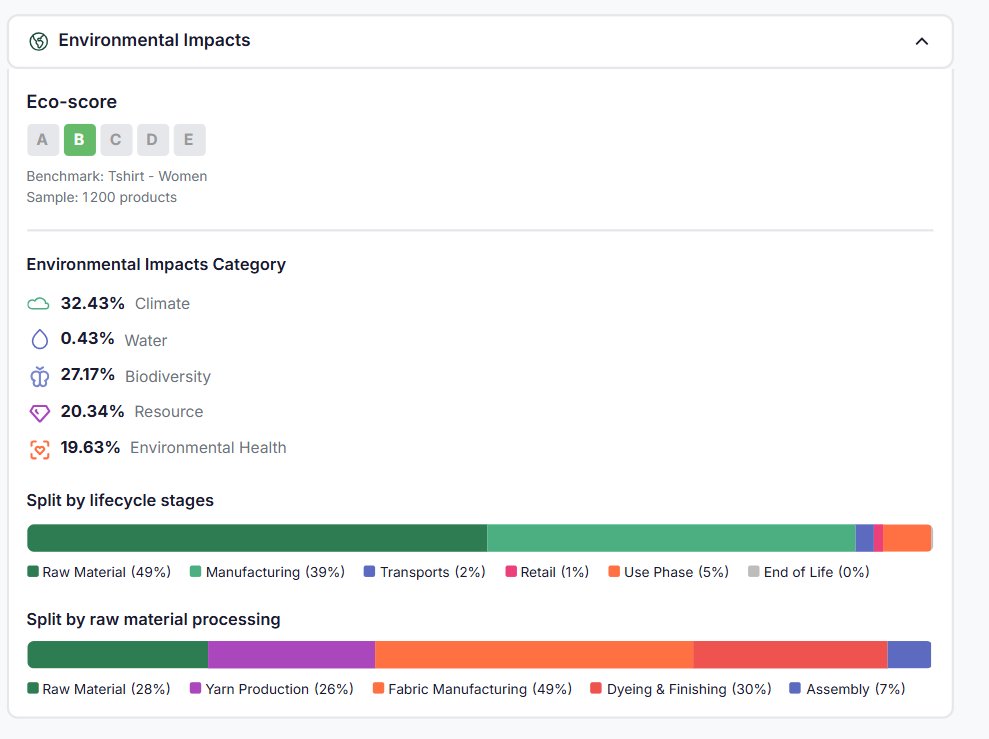
ENVIRONMENTAL IMPACTS
Your supply chain, mapped and visible
- Score breakdown benchmarked against similar products
- Key impact areas: climate, water, biodiversity, resource use
- Lifecycle view: materials, manufacturing, transport, use, end of life
- Production steps: from raw material to finished product
Structured from Ecobalyse results, in a format buyers and customers can actually read.
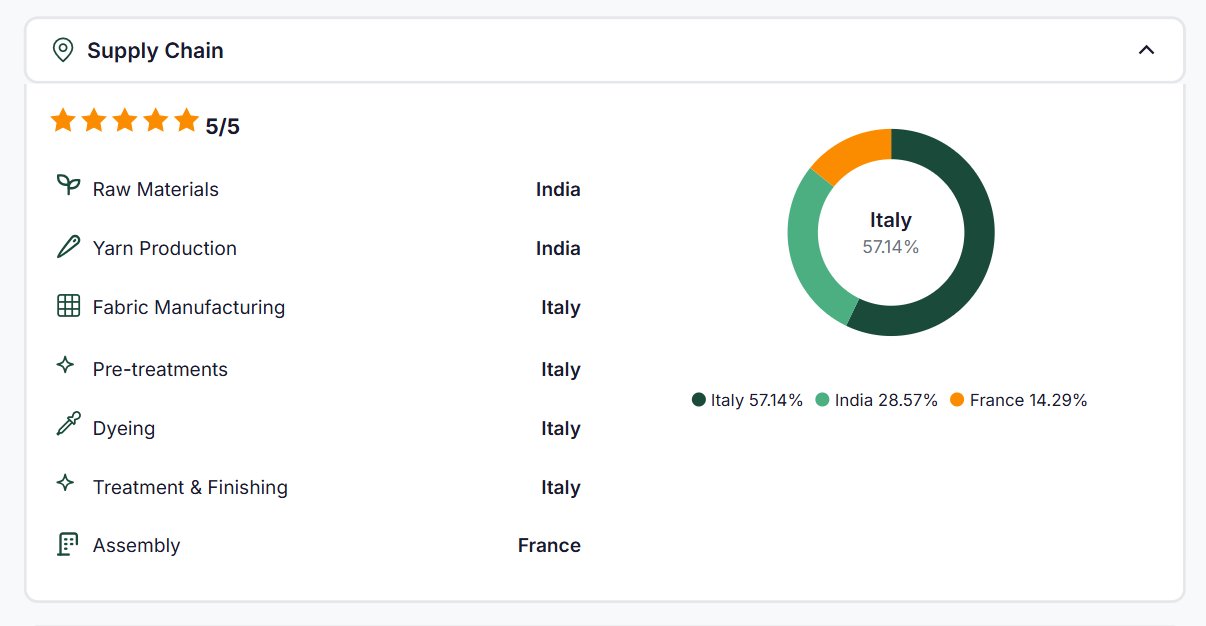
SUPPLY CHAIN
Impact data, made readable
The supply chain section maps each production step to a country and visualises the geographic spread as a chart. A data quality indicator shows the share of supplier-specific data versus modelled or default values. Higher data quality typically improves score accuracy and the strength of the declaration.
- Step-by-step: raw materials, yarn, fabric, pre-treatments, dyeing, finishing, assembly
- Country shown for each production stage
- Geographic split visualised as a donut chart
- Data quality indicator: share of supplier-specific versus default data
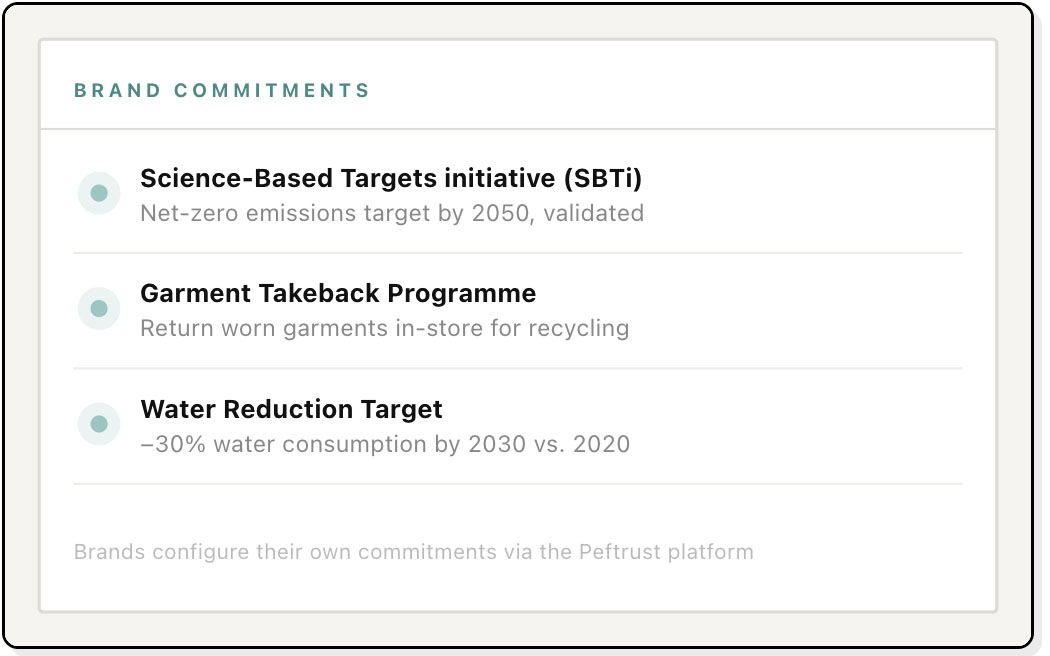
BRAND COMMITMENTS
Sustainability goals, visible alongside the score
Brands can highlight their sustainability commitments on the product page. Unlike unsubstantiated environmental claims, these appear in context with the official Ecobalyse data, grounded in verified data, not standalone claims.
- SBTi targets, takeback programmes, water and materials commitments
- Configured once in Peftrust and shown on every declared product page
- Sits alongside verified score data — not a standalone claim
FULL PAGE VIEW
The complete product environmental page
A single scrollable page at a stable URL, combining the official score, environmental impacts, supply chain detail, brand commitments, product care information, and certifications. This is the page a consumer sees when they scan the QR code, a buyer sees when you share the link, and a retailer sees when they click through from your product listing. Update data in Peftrust and redeclare — the page reflects the change immediately. No reprinting, no broken links.
HOW IT WORKS
From product data to a published page
You provide the product data. Peftrust handles the structuring, modelling, and declaration. The page is generated automatically.
No separate build. No internal dev. No engineering ticket. Peftrust generates the page directly from your declared product data.
01
You provide product data
Materials, weight, manufacturing countries, and key processes. Upload via spreadsheet, API, or direct entry.
02
Peftrust calculates the score
03
Peftrust manages declaration
04
The product page goes live
DELIVERY METHODS
Three ways to bring the score to customers
The regulation requires the score to be accessible at the point of sale, physically or digitally, when environmental claims are made.
📷
QR Code
Print on care labels, hangtags, or packaging. Customers scan to access the full product environmental page. QR codes are generated per SKU and can be exported in bulk for production use.
Meets point-of-sale accessibility requirements
📐
EAN/GTIN shelf label
If your stores use EAN/GTIN electronic shelf labels, Peftrust connects directly via API. The score and key impact data display at the shelf, updating automatically when product data changes in Peftrust.
EAN/GTIN API integration · auto-synced from Peftrust
🌐
Online: link or embed
Link to or embed the page on your product detail pages. Compatible with standard e-commerce platforms and web environments. The URL remains stable, with no need to republish when scores are updated.
Stable URL · iframe-ready · reusable across channels
REGULATORY CONTEXT
What the French Ecobalyse decree requires
Applies to all brands selling textile garments in France, including non-French brands. Brands making environmental claims are expected to align with these requirements. The French ecoscore (Ecobalyse score or coût environnemental) is mandatory for brands making environmental claims on textile products sold in France.
15 Sept 2025
Declaration portal open
1 Oct 2025
Mandatory for brands with environmental claims
1 Oct 2026
Third parties can publish without brand approval
COMMON QUESTIONS
What teams ask before getting started
Can the Ecobalyse product page be customised to match our brand?
Yes. The underlying environmental score and methodology remain fully standardised and aligned with the Ecobalyse framework, but the product page itself can be adapted to your brand. Brands typically customise: visual identity (logo, colours, product imagery); product information and messaging; how the page is integrated into e-commerce or product pages. This allows you to keep a consistent brand experience, while ensuring the environmental score and impact data remain compliant, comparable, and credible.
What does my team actually have to do?
You provide your existing product data: materials, weight, manufacturing countries, and key processes. Peftrust handles the structuring, lifecycle modelling, andscore calculation. Your team reviews key assumptions and validates results before declaration.
Is this the official Ecobalyse score?
Yes. This is the French ecoscore, officially known as the coût environnemental, calculated using the Ecobalyse methodology. Scores are calculated in accordance with the Ecobalyse methodology defined by the French regulatory framework, based on Life Cycle Assessment (LCA) principles and aligned with the European Product Environmental Footprint (PEF) method. The calculation relies on standardised reference data (including datasets integrated within the Ecobalyse and ADEME frameworks) combined with product-specific inputs. Peftrust prepares and submits declarations to the official French Ecobalyse portal. Once declared, the score becomes the official value associated with the product.
What do customers actually see on the product page?
A live, consumer-facing page designed for clarity and transparency, including: the official environmental score (Ecobalyse); a clear impact breakdown and lifecycle view; supply chain steps (raw materials to assembly), with country shown for each stage; brand commitments and product care information. The page reflects your available product and supplier data, with a data quality indicator highlighting what is supplier-specific versus modelled. The same page is used across QR codes, e-commerce, and buyer communication.
What happens if we update product data after the page is live?
You can update data and re-declare at any time. The page updates automatically while keeping the same URL, so there is no need to reprint QR codes or update links.
Do we need full supplier data to get started?
No. Calculations can be performed using available product data, with standardised modelled values applied where inputs are missing, in accordance with the Ecobalyse methodology. These values can be progressively replaced with supplier-specific data to improve precision and reduce reliance on default assumptions.
What happens if we don’t declare?
From October 2026, third parties may publish environmental scores for your products using standardised default data. Declaring ensures your own product data is used, so the score reflects the reality of your products rather than approximations.
Do we need to act before October 2026?
If you make environmental claims, you are already expected to substantiate them with robust, transparent data. From October 2026, the Ecobalyse score will become a central reference for textile products in France. Starting earlier ensures your scores reflect your actual products, not standardised approximations.