

As environmental labelling becomes more visible, especially in France, we often hear the same question from brands:
“What’s the difference between the French environmental score and PEF?
And do we really need both?”
And it’s a great question.
This page explains how the French environmental score is built on the PEF methodology and calculated using Ecobalyse, and how brands should understand the relationship between these frameworks.
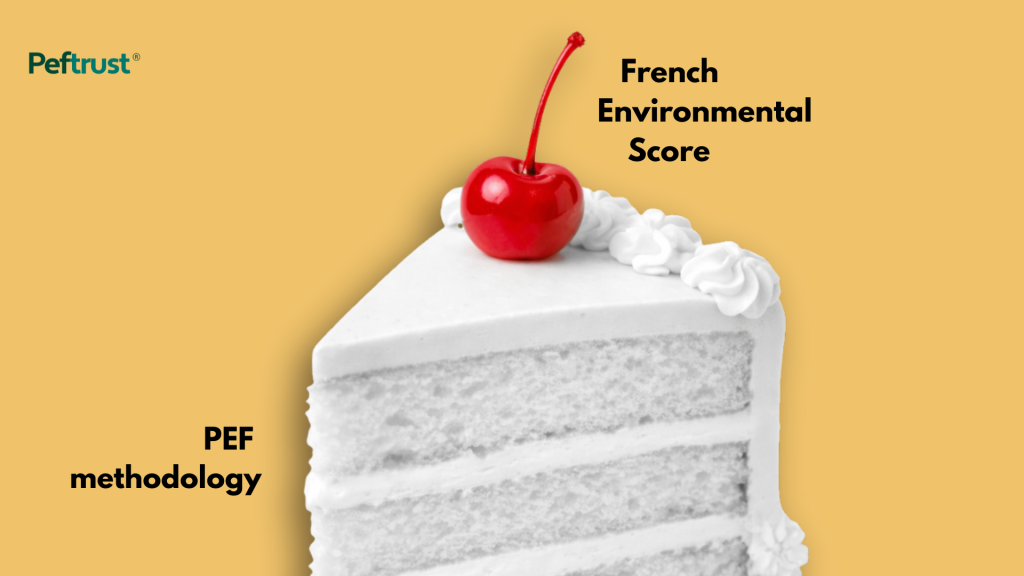
French policymakers often explain the relationship between the two using a simple image: the French environmental score is the cherry on top of the PEF cake.
PEF provides the technical foundation. It’s the part that ensures environmental impacts are calculated in a robust and consistent way. The French environmental score builds on that foundation, translating those results into a format that works for consumer-facing communication.
In other words, the French score doesn’t replace PEF. It sits on top of it.
In practice, this is why many brands don’t treat this as a choice. The French environmental score is used to communicate impact clearly, while PEF is what teams rely on for ecodesign, reporting, and longer-term work.
The French Environmental Score: A Critical Tool for Communication
France has taken a leading role in environmental labelling for clothing.
The French environmental score is designed to make environmental impact understandable and comparable for consumers, directly at the point of sale and on the product’s webpage.
If you want a detailed overview of how the regulation works and how the score is calculated, we cover it in depth here: Pioneering the French Environmental Score Integration
From a brand perspective, the French score is often the first visible step into environmental assessment:
-
- Communicate more transparently about impact
- Build consumer trust
- Introduce environmental scoring in a way that’s easy to explain internally
This isn’t “just marketing.” How brands talk about impact matters, especially when claims are increasingly scrutinised. The French environmental score provides a shared reference point that makes those conversations clearer and more credible.
Where the French Score Fits, and Where It Reaches Its Limits
Because the French environmental score is built for communication, it works best when the goal is to explain impact clearly.
However, as brands go further, especially when they want to:
- Compare productions processes
- Add specific trims, packaging
- Work on ecodesign
- Access to a full customizable LCA
- Report on Scope 3 emissions
- Prepare for broader EU requirements, like Digital Product Passports (DPP)
They often need a methodology that goes deeper.This is usually where PEF enters the conversation.
PEF: Supporting Decisions and Long-Term Work
How Product Environmental Footprint (PEF) is designed to support analysis and decision-making.
It provides a more detailed methodological framework & broader data coverage, which makes it suitable for:
- Ecodesign and product improvement
- Understanding environmental hotspots
- Working with secondary data in a consistent way
- Preparing for EU-level reporting and future requirements
In practice, PEF is what teams rely on when environmental data needs to inform product strategy, not only public communication.
Why Brands Often Use Both
Using both approaches isn’t redundant: it’s complementary.
For many brands:
- The French environmental score supports consumer-facing transparency and regulatory alignment in France
- PEF supports internal work on environmental performance, ecodesign, and long-term readiness
One helps explain impact. The other helps reduce it.
The key is ensuring both are built on consistent data foundations, so teams don’t end up maintaining parallel systems.
As Carolin Bottin, the eco-design leader at KIABI, put it in our recent collaborative whitepaper, Environmental Impact at Scale (click here to download), having a foundation of both scores calculated in Peftrust is vital:
“When the DPP becomes mandatory, it will be a source of pride for us to meet it. Because in fact, we're preparing for it and we're not afraid!”
— Caroline Bottin, Eco-design Leader, Kiabi
The Future of the French Score
It’s also important to look at where things are heading.
The French environmental score is not developing in isolation. It is widely understood as a national implementation that aligns with, and is expected to converge toward, EU-level environmental assessment frameworks, including PEF-based approaches.
For brands, this matters in very practical terms. If environmental scoring is built in a way that’s tightly coupled to a single national format, there’s a real risk of having to redo assessments as EU requirements evolve.
“Both enrich each other. Eventually, we will have a holistic PEF/ Eco-Score system that will have both an internalised eco-design and product evaluation at the moment of purchase.”
— Laurent Bocahut, CEO of Peftrust, in our recent webinar on the French ecoscore with Trustrace
This is why many teams focus early on building data and calculations that can serve both current French requirements and future EU-level scoring, rather than treating them as completely separate exercises.
Making Both Scores Manageable in Practice
This is usually the point where the conversation shifts.
The value of double scoring is clear. What teams worry about is whether it will mean more spreadsheets, more reconciliation, and more time spent explaining numbers internally.
In practice, the questions are very practical:
- How do we keep results aligned across frameworks?
- How do we understand why scores differ without redoing the work?
- How do we avoid building two parallel systems?
- And how do we roll this out across all products that need to be scored?
This is where the way scoring is set up matters more than the methodologies themselves.
At Peftrust, PEF and the French environmental score are handled within the same workflow. For qualifying products, teams can see both scores side by side, using the same underlying data. That makes it easier to understand where results align, where they differ, and why.
The aim isn’t to add another layer to existing processes. It is to support today’s communication requirements while staying aligned with how environmental scoring is expected to evolve at EU level.
What is Next?
With a shared setup, teams can use the French environmental score for clear, consumer-facing communication while relying on PEF for ecodesign, performance improvement, and reporting. Because both are built in, there’s less manual reconciliation and less time spent aligning numbers between teams.
Done this way, double scoring doesn’t feel like doing the work twice.
It becomes a way to connect communication and performance without making day-to-day work heavier.