France’s Eco-Score for Textiles Is Now Official

France’s Eco-Score for Textiles Is Now Official

Peftrust Launches Beta Integration to Help Brands Prepare


It’s official: on May 15, 2025, Agnès PANNIER-RUNACHER, Minister for Ecological Transition, Biodiversity, Forests, the Sea, and Fisheries, announced that the European Commission has validated France’s regulatory framework for voluntary environmental labelling of clothing. This milestone marks a major advancement in sustainability, eco-design, and transparency for the European textile sector.

What Is the Environmental Cost Label?

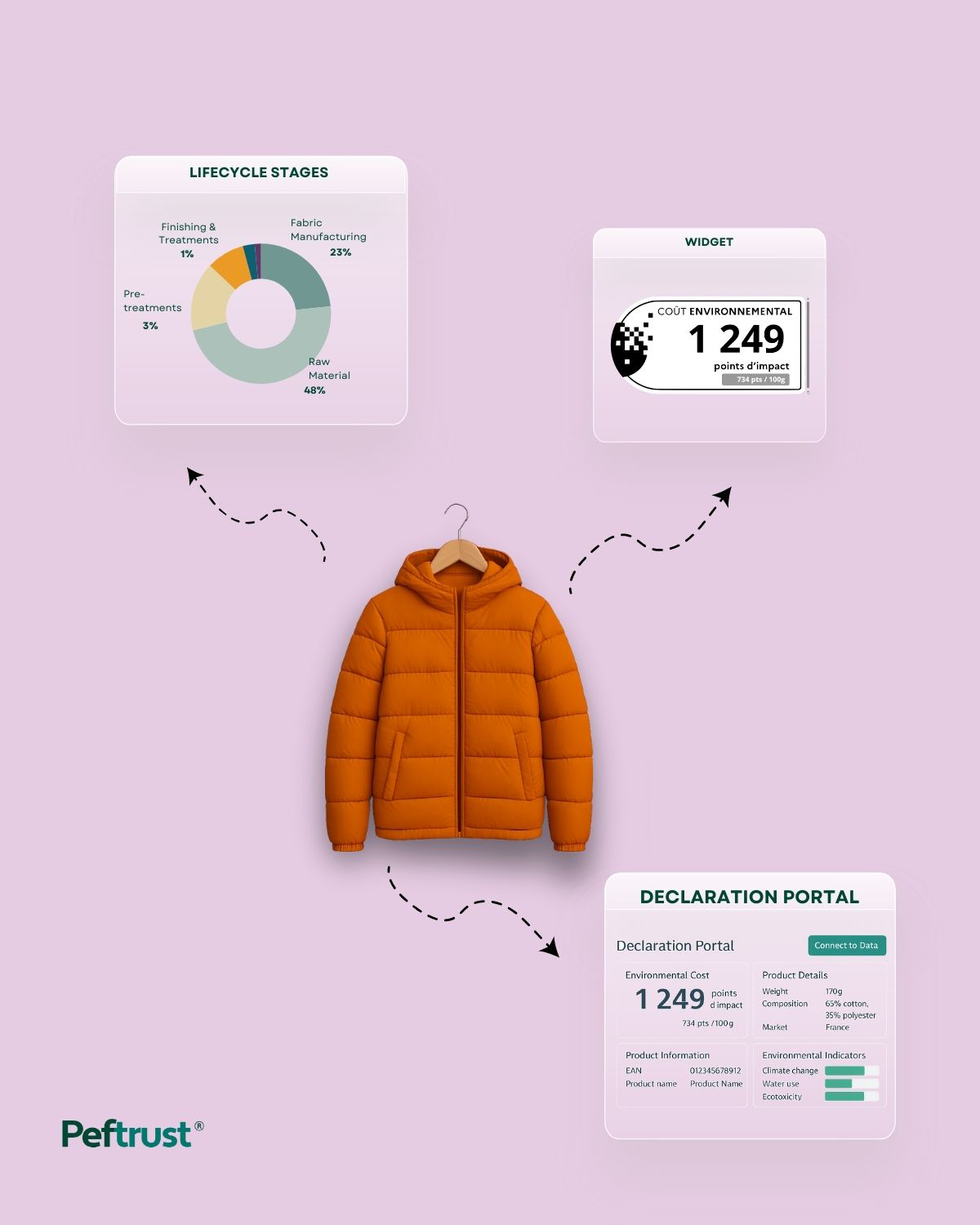
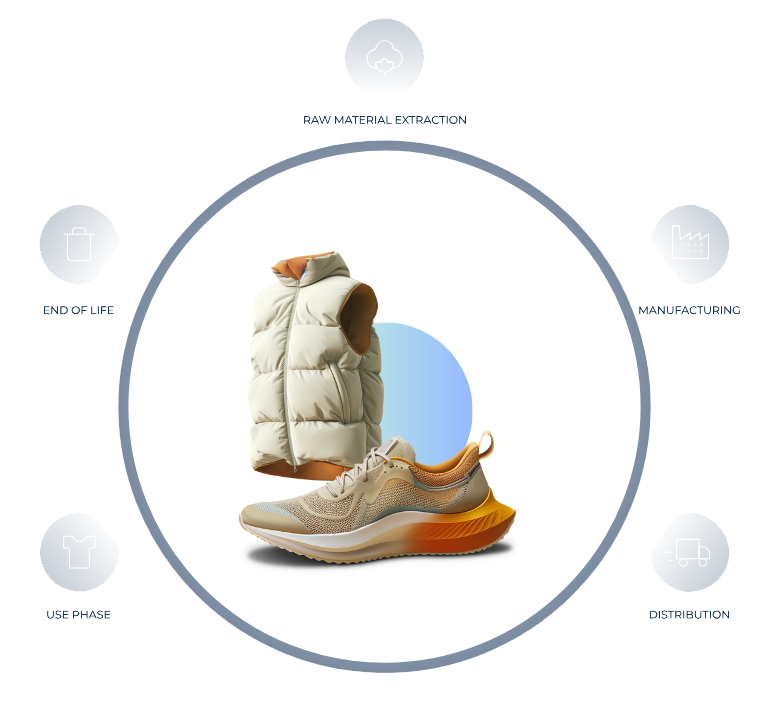
Known as the coût environnemental (environmental cost), the new labelling system evaluates the entire life cycle of a garment, from material production to end-of-life. It measures emission factors such as:

* Carbon footprint

* Water use

* Fossil resource depletion

* Agrochemical usage

* Microfibre emissions

The methodology is based on the Product Environmental Footprint (PEF) developed by the European Commission, with additional metrics tailored to the fashion sector, including durability and non-EU exports.

Following a public consultation in late 2024, the framework is now set for voluntary rollout in the second half of 2025. The goal is to empower consumers with clear environmental information and support manufacturers in driving eco-design improvements.

“With this measure, consumers will be able to know the environmental impact of what they buy, and sustainable producers will stand out,” said Agnès Pannier-Runacher.

Peftrust: Helping You Get Ready Today

To support this transition, Peftrust has launched a beta version of the official eco-score, fully integrated into its platform: ready for real-world testing and implementation.

With Peftrust, brands can:

* Preview official scores using real product data

* Upload product data in bulk: no reformatting headaches

* Generate official environmental scores automatically

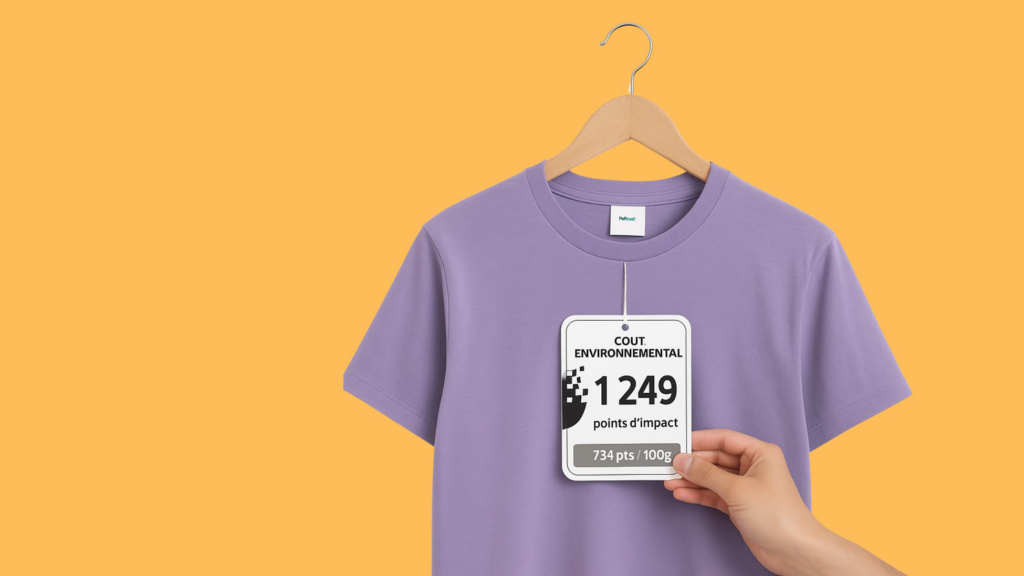
* Create eco-labels for e-commerce, packaging, and in-store displays

* Push data directly to the declaration portal: no extra steps

No additional setup needed, if you’re already using Peftrust, you’re ready.

As France takes the lead in environmental labelling and the EU moves closer to harmonised sustainability scoring, Peftrust remains committed to making PEF, LCA, and eco-design accessible, automated, and scalable for every brand.

France’s Eco-Score for Textiles Is Now Official

Why BUT & Conforama Chose Peftrust to Lead Their Product Sustainability Efforts

Originally published in Information Enterprise No. 194 (April–June 2025), this English translation features an interview with Peftrust® co-founder Laurent Bocahut and highlights how the company supports one of France’s largest home goods retailers, BUT and Conforama, scale their environmental initiatives.

Using data-driven Life Cycle Assessment (LCA), these companies are not only measuring product impact with unmatched precision—they’re redefining what sustainable product development looks like at scale.

The high-precision environmental impact of products

Reducing the environmental footprint of products is no longer a choice—it’s a necessity. With stricter regulations and consumers demanding greater transparency, companies must find ways to assess and reduce their impact accurately.

Yet, precise measurement remains a complex challenge, largely due to scattered and hard-to-use data. Peftrust® offers an innovative answer to this challenge: a powerful technology that automates Life Cycle Assessment (LCA) at scale—with unmatched precision.

Information Enterprise: Why has Life Cycle Assessment become essential for evaluating a product’s environmental impact?

Laurent Bocahut (CEO, Peftrust®): It all starts with measurement. As the saying goes, you can only reduce what you can measure, and you can only improve what you can evaluate. Until the 2020s, product-level environmental impact wasn’t well quantified. The focus was mostly on corporate footprints, especially carbon reporting.

But over time, it became clear that for companies—fashion brands, for example—around 90% of their impact came from the products themselves. That shifted the key question to: How do we measure that footprint? The answer is Life Cycle Assessment (LCA), which provides a thorough, reliable view of a product’s environmental profile.

I.E.: Can you explain how Peftrust® addresses this?

Laurent Bocahut: Traditionally, LCA has been performed one product at a time using specialized software—often slow and requiring expert input. But for large retailers like Carrefour, Kiabi, BUT, or Conforama, managing tens or hundreds of thousands of SKUs, this isn’t sustainable.

That’s where Peftrust® comes in. Our platform enables companies to perform LCAs at scale—efficiently and dynamically. Unlike traditional tools that offer a static score, our technology evolves with the product, its supply chain, and data sources.

Our real strength? We’re a data-first solution, purpose-built to handle massive datasets and deliver high-precision environmental assessments.

I.E.: How does Peftrust® turn raw company data into meaningful, actionable LCA results?

Laurent Bocahut: Most brands already hold a wealth of data—they just don’t always realise it. It’s scattered across departments like product development, supply chain, ERP systems, and traceability tools.

Our role at Peftrust® is to equip brands with the tools to identify, process, and analyse this data to perform LCAs. Importantly, companies don’t need to pre-format anything. Our system automatically converts and structures the data before sending it to our high-frequency computing engine. Throughout the process, brands retain full control and visibility over their data.

I.E.: What effect does environmental labeling have on consumer behavior?

Laurent Bocahut: It’s becoming a major force for change. Consumer behavior is evolving rapidly, especially in response to eco-scores.

Recent studies show that environmental labeling—similar to the Nutri-Score system in food—significantly influences buying decisions in non-food categories. We’re seeing that roughly 40% of purchasing decisions shift toward products with environmental information, and that trend is even stronger for top-rated items (A or B).

This momentum is being reinforced by regulation. France recently submitted a decree on textile environmental labeling to the EU (February 13), setting the stage for rollout in 2025. Fashion will be the first sector, but there’s already discussion of expanding it to home goods and cosmetics.

At Peftrust®, we’re already supporting our clients through this shift, offering reliable, data-powered eco-design tools tailored to today’s rising consumer expectations.

Client perspective: BUT-Conforama on Eco-Design

What’s driving BUT-Conforama toward eco-design?

Brondon Tchienkoua, Eco-design Project Manager, BUT Conforama Group: BUT and Conforama are two longstanding key players in the French home goods market. Our commitment to the ecological transition reflects our position in the industry. We see this moment as an opportunity—to mobilise the sector, innovate, and reimagine how we do business in line with the future.

The products we put on the market account for over 80% of our Scope 3 carbon footprint. That’s why environmental impact has become a critical factor in how we design and develop our products—to meet the urgent demands of decarbonisation.


How are you measuring and reducing the environmental impact of your products?

B.T: We’ve created an environmental performance benchmark for our products called Habitons Mieux. This method, grounded in Life Cycle Assessment, helps us pinpoint the key areas where eco-design can make a difference, based on defined criteria.

To further this initiative, we’ve partnered with Peftrust® to roll out Life Cycle Assessments at scale across our product range. This collaboration allows us to industrialise the process, bring greater accuracy and regulatory alignment to how we measure environmental impact, and track the tangible benefits of our eco-design efforts.


What are your three keys to success?

B.T: Our three keys to success are :

1/ Engaging our full ecosystem from industrial partners and sourcing teams to internal staff—in the mission to measure and reduce our products’ environmental footprint.

2/ Positioning the BUT-Conforama Group as a responsible leader in the home goods sector.

3/ Staying ahead of regulations by embedding nationally and EU-endorsed best practices into our processes.

Understanding the Basics of the Product Environmental Footprint (PEF)

Part One:The Basics


Winter is coming.❄️

Last week we had the pleasure of presenting to joint members of the European Outdoor Group (EOG) and the Bundesverband der Deutschen Sportartikel-Industrie e.V. (BSI). We discussed why a standardized approach to environmental impact assessment is crucial for the outdoor sector. Especially as brands aim to measure and report their environmental impact accurately.

There were many great questions, and we wanted to share a snapshot of the key takeaways from that presentation here.

PEF is a standardized approach developed by the European Commission to measure and communicate products’ environmental footprint throughout their lifecycle. It ensures consistent environmental claims across the EU, enabling brands to compare their products fairly and transparently.

The Environmental Footprint, or EF, is a method developed to help companies compare and improve their environmental impact. It provides a common set of rules tailored for the European market. They are called the Product Environmental Footprint Category Rules (PEFCR).

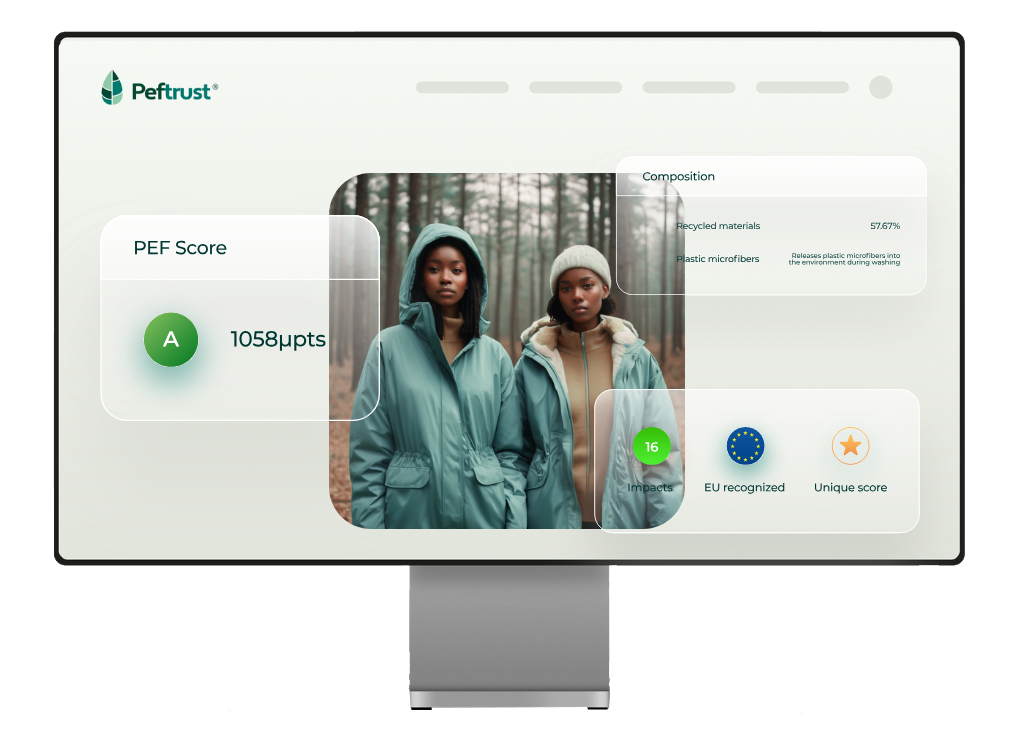
The PEFCR provide specific guidelines for calculating product impacts, covering 16 environmental categories such as climate change, resource use, and water consumption.

For outdoor brands, sustainability is more than a trend—it’s a core value. The PEF methodology offers a standardized, EU-approved way to assess and reduce Scope 3 emissions, which often make up the majority of a brand’s environmental impact. By using PEF, brands can evaluate sourcing choices, material selection, and production processes to drive sustainability.

* Standardization: PEF provides a consistent method for comparing products across sectors.

* Regulatory Compliance: As EU regulations on environmental claims tighten, PEF ensures compliance.

* Holistic Approach: The methodology covers the full product lifecycle, from raw materials to end-of-life.

* Consumer Trust: With data-backed assessments, PEF builds consumer confidence in your environmental claims.

The Product Environmental Footprint (PEF) method offers a standardized approach to measuring a product’s environmental impact across its entire life cycle, aligning with ISO standards 14040 and 14044. It’s a comprehensive way to understand the full environmental impact of a product, from raw material extraction to end-of-life disposal.

PEF follows the Product Environmental Footprint Category Rules (PEFCR), which provide detailed guidelines for specific industries. For example, the PEFCR for Apparel & Footwear v2.0 covers the entire product lifecycle for this sector. PEF uses EF Mid-point Indicator 3.1 for impact assessment, which acts like “checkpoints” for environmental impacts, such as resource use and pollution, before assessing the overall harm to health or the planet. These indicators help brands identify the stages in their product’s lifecycle—like production, transportation, or disposal—that have the most significant environmental impacts.

To ensure fair comparisons and consistency, PEF uses European weighting and normalization factors, allowing it to be applied broadly across different sectors and products, while incorporating 16 distinct environmental impact indicators.

PEF is powered by an extensive database of over 5,500 datasets from sources like Ecoinvent, Blonk, and Thinkstep, providing detailed, diverse data for accurate impact analysis. Additional databases offer further enrichment to results, enabling brands to fine-tune their assessments based on specific materials or processes.

The PEF Score reflects the total environmental footprint of a product over its expected lifespan. For instance, if you have a pair of shoes designed to last a year, the PEF will calculate the environmental impact based on that full year of use. Longer-lasting products will generally have a lower impact per day because the environmental cost is spread over a more extended period.

The PEF methodology offers a powerful, standardized framework for outdoor brands to measure, reduce, and communicate their environmental impact. By using PEF, companies can ensure compliance with EU regulations, build consumer trust, and take a holistic approach to sustainability. From sourcing raw materials to managing end-of-life disposal, the PEF methodology provides a consistent way to evaluate and improve a product’s environmental footprint across its entire lifecycle.

In Part 2, we’ll dive deeper into the lifecycle analysis process. We’ll explore how PEF helps track long-term environmental progress, and look at a real-world example of PEF in action. Stay tuned to see how this methodology can drive even greater sustainability for your brand.

Cant wait for part two? Sign up for a demo

Durability in Fashion: From Regulation to Innovation

The Durability Challenge: Embracing Sustainable Practices for Fashion Brands and Consumers

What challenges are brands facing? What are the solutions for making collections sustainable? How can brands and consumers act in favor of sustainability? Discover the answers in this article.

Continue reading