On 27 May 2026, Peftrust hosted a live Q&A with Pascal Dagras and Camille Martin of the French Ministry of Ecological Transition. Brands asked the questions. The Ministry answered. This report compiles all 24, from what changes on 1 October 2026, to how third-party scoring works, to why ecotoxicity is weighted at 21 per cent.
What Is the French Environmental Cost Display?
The French Environmental Cost Display (affichage du coût environnemental) is the next phase of France’s environmental transparency framework for textiles. Built on the Ecobalyse methodology, it is designed to help consumers understand the environmental impact of products through a standardized scoring approach.
As implementation approaches, brands are facing important questions about data quality, supplier engagement, product modelling, and publication requirements. While the methodology continues to evolve, one thing is clear: preparation will take time, and organizations that begin early will be in a stronger position when the system becomes operational.
What Brands Asked the Ministry
During Peftrust’s live Q&A session with the French Ministry of Ecological Transition, brands raised practical questions about how the system will work in reality. Topics included the relationship between AGEC and the Environmental Cost Display, the role of third-party scoring providers, how layered garments should be modelled, and why ecotoxicity currently represents 21 percent of the overall score.
Questions also focused on publication requirements, portal registration, supplier data collection, and the responsibilities of brands when environmental scores are generated by external organizations. These are not theoretical questions. They are the operational challenges that sustainability, compliance, sourcing, and product teams are already beginning to address.
Preparing for October 2026
The October 2026 milestone is approaching quickly for brands that have not yet started preparing. Successful implementation requires more than calculating a score. Organizations must identify pilot products, define internal ownership, collect supplier information, establish data governance processes, and select the right technology partner.
The Industry Q&A Report brings together all 24 questions submitted during the session, along with additional implementation guidance validated against the latest Ecobalyse methodology. Whether your organization is evaluating its first pilot or planning a full-scale rollout, the report provides practical insight into what comes next and how to prepare effectively.
From existing product data to a structured Data Blueprint, AI mapping prepares everything needed for LCA, DPP and French Ecoscore
Fashion brands that invest in environmental data infrastructure are not just preparing for regulation. They are building a competitive advantage: the ability to make faster product decisions, communicate with credibility, and lead on sustainability rather than follow
We sat down with Mathilde Mével, Head of Product at Peftrust, to understand how the platform’s new AI-powered data mapping feature works in practice and what it means for sustainability and product teams trying to move faster.
Getting to Calculation: The Data Foundation That Changes Everything
Most sustainability managers already understand LCA methodology. What they want is to spend less time preparing data and more time using it. Generating an environmental score, whether for the French affichage environnemental, a DPP-compatible EU submission, or an internal eco-design roadmap, requires structured product data: material composition, component weights, accessory details, and consistent measurement units.
Getting that data ready has traditionally been the slow part. It sits across departments and systems, held by different people in different formats. Pulling it together takes time that teams would rather spend on strategy and action.
There is a principle worth keeping in mind here: LCAs don’t reward more data, they reward the right data. Brands do not need a perfect dataset to get started. They need a structured one.
That is exactly what Peftrust’s new AI data mapping feature delivers.
"Once teams have clean, structured data, everything moves quickly. The calculation itself is fast. The analysis is fast. The decisions become possible. Our goal was to make that first step as easy as it should be."
AI-Supported Data Mapping: Start From Where You Are
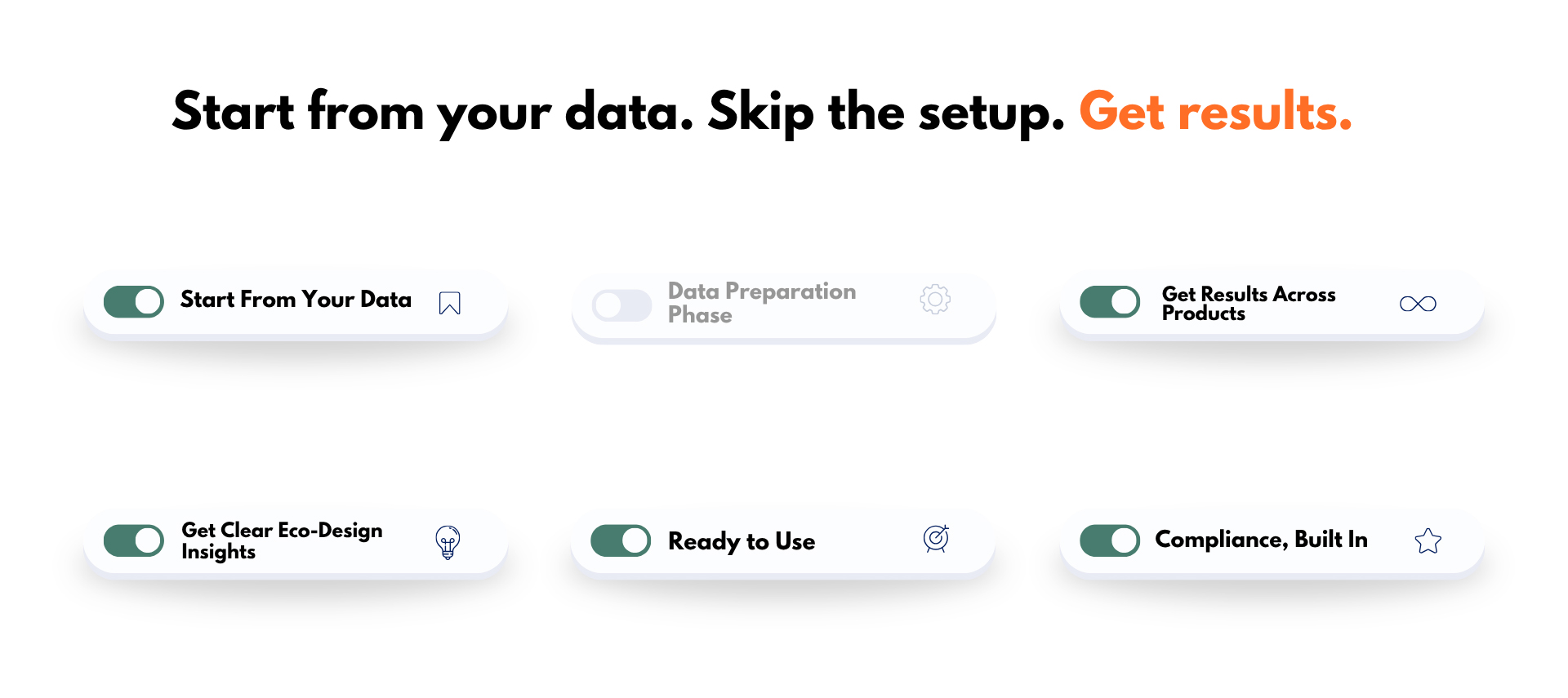
Peftrust has always offered ways to structure and organise brand data within the platform. What the new AI layer changes is the starting point: brands can now begin with the data they actually have, rather than spending weeks preparing it first.
What Brands Get
Brands can upload the product file they already have and quickly obtain structured, ready-to-use product data within the Peftrust platform.
Where information is incomplete, results draw on Peftrust’s validated internal benchmarks or brand-specific assumptions. The outputs remain transparent and fully traceable.
The positioning is deliberate: AI-supported. LCA engineer validated.
LCAS DON'T REWARD MORE DATA. THEY REWARD THE RIGHT DATA. THE GOAL IS SIMPLE: GET TEAMS OUT OF DATA PREP AND INTO DECISIONS.
The Output: A Data Blueprint
Think of it like building a house. Before you choose the paint colour or hang the front door, the foundations have to be right. The Digital Product Passport, the French Ecoscore, and the environmental disclosures brands share with the world: these are the visible layer. What the Data Blueprint does is ensure everything underneath is solid, structured, and documented before anything is built on top of it.
Like an architectural plan, it does not just describe what exists. It sets out exactly what was decided, why, and by whom. Every assumption recorded. Every source referenced. Engineers sign off before anything moves forward.
Energy Redirected, Time Reclaimed
What used to require coordination across sustainability, product, sourcing, and sometimes IT, over weeks or months, now happens in a fraction of the time. Teams that previously spent their energy consolidating and cleaning data can redirect that energy toward analysis, decision-making, and action.
"The goal was never to automate for automation's sake. It was to give sustainability teams back the time to do the work that actually matters to them."
Stop Rebuilding. Start Scaling.
A Regulatory Window That Rewards Early Movers
The EU’s ESPR regulation and Digital Product Passport framework are creating a new baseline for what fashion brands need to demonstrate about their products. The DPP for textiles will require product-level environmental data, including LCA-based scores, material traceability, and repair and end-of-life information, to be accessible digitally for every product placed on the EU market.
Brands that have already been building toward the French affichage environnemental, which has beenlive on products in the French market since Oct 2025, are in a strong position. The methodology is closely aligned with PEF, meaning their existing data infrastructure transfers directly. Getting DPP-ready is not starting from scratch. For many brands, it is completing a journey already underway.
"Brands that have invested in good data practices are going to find this transition much smoother than they expect. And those that start now still have time to build a real advantage."
The Platform That Grows With You
Peftrust’s roadmap is built around a single ambition: a guided environment where sustainability teams have everything they need in one place, from the first data upload to the final disclosure.
“We want sustainability teams to feel like they have a partner that understands the complexity of what they are doing,” says Mathilde. “Not a tool that creates more work, but one that makes the right decisions obvious.”
Key Takeaways
Start with the data you already have. Peftrust’s AI mapping handles the structuring and produces an audit-ready Data Blueprint.
Trust the gaps to be filled intelligently, using LCA-validated benchmarks or your own assumptions, never arbitrary values.
Know that every score follows EU PEF methodology and every assumption is documented, so disclosures and audits are straightforward.
If you are already working toward the French affichage environnemental, you are closer to DPP-ready than you think. Your data infrastructure transfers directly.
Reclaim the months your team used to spend on data preparation and redirect that time toward decisions that actually move the needle.
This was a central theme at the Scandinavian Outdoor Group Sustainability Day 2026 in Stockholm, where sustainability leaders from across the industry gathered to discuss practical approaches to environmental assessment. The consensus was clear: outdoor brands need tools that match their ambition.
Product Environmental Footprint (PEF) is becoming a core framework for measuring product-level environmental impact. This article explains what PEF enables today, its limitations, and how it supports eco-design, Digital Product Passports (DPP), and ESPR compliance.
Environmental transparency has never been the issue for outdoor brands. The industry is built on respect for nature, producing gear designed to last, withstand harsh conditions, and align with sustainable values. What has been missing is the infrastructure to back those values: reliable data collection, standardised measurement systems, and frameworks that fit into existing production processes.
Product Environmental Footprint (PEF) has emerged as one of the most robust frameworks for product-level environmental assessment. Each PEF is developed by the European Commission with technical secretariats representing industrial key experts and integral stakeholders, creating and aligning on the unique category rules for each sector The PEFCR A&F (Apparel and footwear) provides the fashion industry and outdoor sector with a standardised method for calculating and communicating the environmental performance of products across their full life cycle.
Denby Royal, Head of Sales at Peftrust, presenting PEF to the members of the Scandinavian Outdoor Group
For outdoor brands, where durability, technical performance, and environmental responsibility converge, understanding PEF is increasingly essential. This article addresses practical questions based on real-world experience working with apparel, footwear, and outdoor brands on product-level environmental assessments.
Building a Solid Foundation for Environmental Transparency
PEF is not about achieving the best score or crafting the cleanest sustainability story. It is about building a solid foundation, one that includes full life cycle assessment, durability modelling, and use phase impacts, one that uses shared rules and databases so results hold together under scrutiny.
For outdoor brands, this foundation is particularly valuable. Products built to last can demonstrate genuine environmental advantages. Repair programmes and quality construction become quantifiable benefits. The values the outdoor industry has long championed, respect for nature, durability, and production, can be substantiated with credible, comparable data.
In practice, the questions brands ask are specific: What is PEF actually useful for today? Where does comparison work, and where do expectations go wrong? Can primary data be used, or is everything locked to defaults? And how do durability and lifetime really affect results? The sections that follow address each of these directly.
What Is PEF and How Does It Work?
PEF is a life cycle assessment (LCA) methodology that measures environmental impact from raw material extraction through manufacturing, distribution, use, and end of life. Unlike simplified carbon footprinting, PEF covers sixteen impact categories, including climate change, water use, biodiversity, resource depletion, and ecotoxicity.
The framework succeeds because it addresses three challenges simultaneously: scope, impact coverage, and modelling rules. When brands compare different LCA studies and find wildly different results, it is usually because one of these elements varies between methodologies. PEF standardises all three, creating a common foundation for meaningful comparison.
This standardisation does not eliminate methodological debate, especially on contested materials such as wool or bio-based synthetics. What PEF does is move debates into a defined framework where assumptions become explicit and consistent rather than implicit and scattered. The debates become more visible, which is precisely the point.
PEFCRs define how specific product categories should be assessed. For apparel and footwear, these rules ensure valid comparisons: jackets compared to jackets, boots compared to boots. This category-specific approach prevents misleading comparisons between fundamentally different product types.
The rules also specify which data sources are acceptable, how to handle data gaps, and what default values apply when primary data is unavailable. This consistency is what makes PEF results comparable across brands and products.
Why PEF Matters for Outdoor Brands
Outdoor products present unique challenges for environmental assessment. Technical garments and footwear involve complex material combinations, including membranes, treatments, reinforcements, and hardware, that simpler methodologies struggle to capture accurately. A single jacket might include a dozen different materials, each with distinct environmental profiles.
PEF handles this complexity without oversimplifying. Under the PEF methodology, product complexity stays visible rather than being smoothed out. More materials and components mean more data to model. When specific data is unavailable, conservative default values provide a consistent foundation and set the stage for assessment, ensuring results remain comparable while data quality improves over time.
More importantly, PEF models product lifetime and use phase, which matters enormously for outdoor brands where durability is a core value proposition. Washing frequency, maintenance requirements, and expected product lifespan all factor into the assessment.
Durability Becomes a Measurable Advantage
PEF is a weight-based methodology, meaning material mass directly influences the score. However, a heavier product can still score better than a lighter alternative if it lasts longer and replaces multiple products over time. This is not marketing spin. It is how the methodology accounts for durability. When a product lasts twice as long, its environmental burden spreads across twice as many uses.
For outdoor brands built on quality and longevity, this represents a significant opportunity. Repair programmes, durable construction, and longevity design become quantifiable environmental benefits rather than just brand positioning.
Key Benefits of PEF for Sustainability Teams
Data Driven Eco Design Decisions
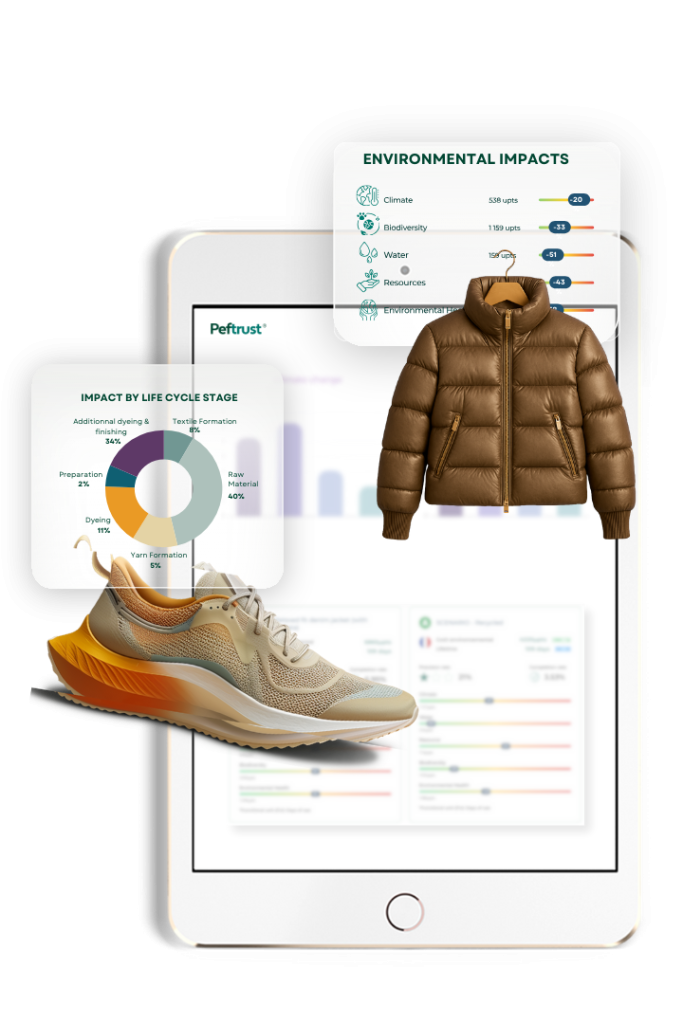
When disaggregated default data is available, PEF can help build scenarios where environmental impact concentrates within a product’s lifecycle. If raw materials dominate, often accounting for 40% of total impact, material selection becomes the priority. If dyeing and finishing contribute significantly, process innovation matters most.
Design teams can model alternatives before committing to production. What happens with recycled polyester versus virgin polyester? How does a different membrane affect the overall footprint? PEF can help provide quantified answers that inform real decisions.
Product Level Scope 3 Insights
For brands working on corporate emissions accounting, PEF provides the product-level granularity that Scope 3 reporting requires. The full life cycle approach captures upstream and downstream impacts, helping identify which products and categories contribute most to corporate footprint.
Regulatory Readiness
EU policy increasingly references PEF methodology. The Green Claims Directive, Digital Product Passport requirements, and Ecodesign for Sustainable Products Regulation are all leaning towards an alignment with PEF-based approaches. Brands that build PEF capability now are better prepared to apply consistent, product-level LCAs across eco-design, Scope 3 analysis, and future disclosure needs, without having to rework their foundations later.
Understanding the Limitations of PEF
Using PEF effectively requires understanding what it is designed to do, and what it is not.
PEF was not built as a standalone consumer message. It is a technical methodology designed to produce consistent, comparable product-level results across multiple impact categories. For this reason, PEF is most often used as the backbone behind consumer-facing labels or scores, rather than communicated directly. The French environmental display score is a good example of how PEF-based results can be translated into a format that is accessible to consumers.
Data gaps remain, particularly for innovative materials and novel processes common in technical outdoor products. Where gaps exist, conservative defaults apply, which may not fairly represent products that genuinely perform better. The good news is this gap is starting to close as more upstream material producers and process owners can now provide primary datasets, but collecting, validating, and maintaining that data at scale still takes real time and effort.
PEF is a technical methodology, but most of the complexity sits in the rules and calculations themselves. In practice, platforms handle this automatically, allowing teams to focus on understanding the results and using them to inform eco-design, sourcing, and product decisions. The learning curve is real, but it is manageable, and brands do not need to become LCA experts to benefit from the framework.
How to Get Started with PEF
For most brands, PEF works best when approached progressively rather than all at once.
Start with strategic products. Begin with high-volume items, flagship products, or those under stakeholder scrutiny. Working on a focused scope makes internal capability manageable while delivering immediate value.
Build data infrastructure progressively. Start with EF or PEF-compliant databases for defaults, then replace them with primary data for impactful areas, typically materials and key processing stages. Supply chain clarity can become increasingly visible as data maturity develops.
Connect to business processes. The most successful implementations integrate footprint datainto design reviews, material selection criteria, and supplier evaluation frameworks. When PEF results inform decisions, the investment yields returns.
The Road Ahead
The journey from first assessment to mature capability takes time. Data gaps must be filled. Internal processes must adapt. Supply chains must be engaged. But the direction is clear: verified, standardised product environmental data will be increasingly expected by consumers, regulators, and stakeholders alike.
Brands that invest now position themselves ahead of regulatory requirements and competitive pressures. They reduce compliance risk, improve calculation accuracy, streamline supplier exchanges, and build the data infrastructure needed for Digital Product Passport requirements expected from 2027.
PEF offers a proven, structured, internationally recognised approach to meeting that expectation. For brands ready to move beyond approximate claims toward verified environmental performance, it provides exactly what its name promises: a solid foundation for understanding product environmental footprint.
Peftrust is a product-level environmental data platform for apparel, footwear, outdoor, and home goods brands. It turns methodologies like PEF into usable product data for eco-design, Scope 3 analysis, and day-to-day product decisions, not just reporting.
As environmental labelling becomes more visible, especially in France, we often hear the same question from brands:
“What’s the difference between the French environmental score and PEF? And do we really need both?”
And it’s a great question.
This page explains how the French environmental score is built on the PEF methodology and calculated using Ecobalyse, and how brands should understand the relationship between these frameworks.
French policymakers often explain the relationship between the two using a simple image: the French environmental score is the cherry on top of the PEF cake.
PEF provides the technical foundation. It’s the part that ensures environmental impacts are calculated in a robust and consistent way. The French environmental score builds on that foundation, translating those results into a format that works for consumer-facing communication.
In other words, the French score doesn’t replace PEF. It sits on top of it.
In practice, this is why many brands don’t treat this as a choice. The French environmental score is used to communicate impact clearly, while PEF is what teams rely on for ecodesign, reporting, and longer-term work.
The French Environmental Score: A Critical Tool for Communication
France has taken a leading role in environmental labelling for clothing.
The French environmental score is designed to make environmental impact understandable and comparable for consumers, directly at the point of sale and on the product’s webpage.
From a brand perspective, the French score is often the first visible step into environmental assessment:
Communicate more transparently about impact
Build consumer trust
Introduce environmental scoring in a way that’s easy to explain internally
This isn’t “just marketing.” How brands talk about impact matters, especially when claims are increasingly scrutinised. The French environmental score provides a shared reference point that makes those conversations clearer and more credible.
Where the French Score Fits, and Where It Reaches Its Limits
Because the French environmental score is built for communication, it works best when the goal is to explain impact clearly.
However, as brands go further, especially when they want to:
Compare productions processes
Add specific trims, packaging
Work on ecodesign
Access to a full customizable LCA
Report on Scope 3 emissions
Prepare for broader EU requirements, like Digital Product Passports (DPP)
They often need a methodology that goes deeper.This is usually where PEF enters the conversation.
PEF: Supporting Decisions and Long-Term Work
How Product Environmental Footprint (PEF) is designed to support analysis and decision-making.
It provides a more detailed methodological framework & broader data coverage, which makes it suitable for:
Ecodesign and product improvement
Understanding environmental hotspots
Working with secondary data in a consistent way
Preparing for EU-level reporting and future requirements
In practice, PEF is what teams rely on when environmental data needs to inform product strategy, not only public communication.
Why Brands Often Use Both
Using both approaches isn’t redundant: it’s complementary.
For many brands:
The French environmental score supports consumer-facing transparency and regulatory alignment in France
PEF supports internal work on environmental performance, ecodesign, and long-term readiness
One helps explain impact. The other helps reduce it.
The key is ensuring both are built on consistent data foundations, so teams don’t end up maintaining parallel systems.
As Carolin Bottin, the eco-design leader at KIABI, put it in our recent collaborative whitepaper, Environmental Impact at Scale (click here to download), having a foundation of both scores calculated in Peftrust is vital:
“When the DPP becomes mandatory, it will be a source of pride for us to meet it. Because in fact, we're preparing for it and we're not afraid!”
The Future of the French Score
It’s also important to look at where things are heading.
The French environmental score is not developing in isolation. It is widely understood as a national implementation that aligns with, and is expected to converge toward, EU-level environmental assessment frameworks, including PEF-based approaches.
For brands, this matters in very practical terms. If environmental scoring is built in a way that’s tightly coupled to a single national format, there’s a real risk of having to redo assessments as EU requirements evolve.
“Both enrich each other. Eventually, we will have a holistic PEF/ Eco-Score system that will have both an internalised eco-design and product evaluation at the moment of purchase.”
This is why many teams focus early on building data and calculations that can serve both current French requirements and future EU-level scoring, rather than treating them as completely separate exercises.
Making Both Scores Manageable in Practice
This is usually the point where the conversation shifts.
The value of double scoring is clear. What teams worry about is whether it will mean more spreadsheets, more reconciliation, and more time spent explaining numbers internally.
In practice, the questions are very practical:
How do we keep results aligned across frameworks?
How do we understand why scores differ without redoing the work?
How do we avoid building two parallel systems?
And how do we roll this out across all products that need to be scored?
This is where the way scoring is set up matters more than the methodologies themselves.
At Peftrust, PEF and the French environmental score are handled within the same workflow. For qualifying products, teams can see both scores side by side, using the same underlying data. That makes it easier to understand where results align, where they differ, and why.
The aim isn’t to add another layer to existing processes. It is to support today’s communication requirements while staying aligned with how environmental scoring is expected to evolve at EU level.
What is Next?
With a shared setup, teams can use the French environmental score for clear, consumer-facing communication while relying on PEF for ecodesign, performance improvement, and reporting. Because both are built in, there’s less manual reconciliation and less time spent aligning numbers between teams.
Done this way, double scoring doesn’t feel like doing the work twice.
It becomes a way to connect communication and performance without making day-to-day work heavier.
What Should We Be Measuring in Mixed-Material Apparel?
This is a question we heard recently, directly from a client.
While our initial response was short and practical, we thought it deserved a deeper dive.
As sustainability becomes a core business requirement, brands involved in designing apparel that uses both natural and synthetic fibres must take a more comprehensive approach to environmental impact.
For example, the production of synthetic fibres, including polyester, is heavily reliant on petroleum, resulting in resource depletion and considerable greenhouse gas emissions. On the other hand, natural fibres, such as cotton, require substantial water resources and may contribute to environmental degradation
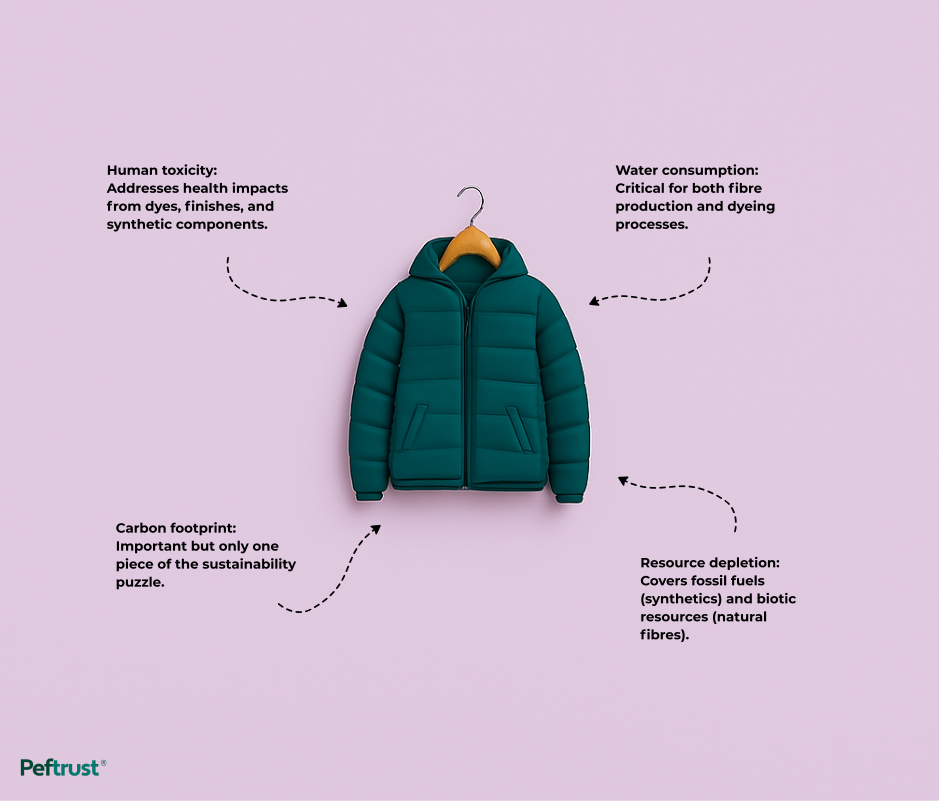
To navigate these challenges, our sustainability experts have identified several key factors that should shape ecodesign strategies:
1/ Water consumption Critical for both fibre production and dyeing processes
2/ Human toxicity Addresses health impacts from dyes, finishes, and synthetic components
4/ Carbon footprint Important but only one piece of the sustainability puzzle
By addressing these impact areas, brands can create more environmentally responsible products with a comprehensive sustainability perspective.
Leveraging platforms like Peftrust can further enhance this transition, providing the tools needed to improve sustainability across the industry.
Why Ecodesign Needs an Upgrade in 2025
Research indicates that up to 80% of a product’s environmental impact is determined during the design phase. Yet, many brands treat sustainability as an afterthought, focusing primarily on carbon emissions without considering other equally important factors.
As industries face increasingly complex environmental challenges, sustainability is no longer optional – it’s essential for business success and regulatory compliance. With evolving frameworks such as the Digital Product Passport (DPP) and Extended Producer Responsibility (EPR), brands must transition from good intentions to robust, data-driven ecodesign strategies that address the full spectrum of environmental impacts.
By implementing multi-impact assessment approaches in the design phase, brands can:
* Make evidence-based material and process selections
* Ensure compliance with emerging regulations
* Build consumer trust through transparent sustainability claims
At Peftrust, our recent Coffee Pause Webinar with industry expert, Gianluca Manago, highlighted that effective ecodesign requires a comprehensive understanding of the entire product life cycle – not just carbon reduction. This article shares key insights to help brands navigate the evolving ecodesign landscape.
Four Essential Ecodesign Principles Every Brand Should Know
1/ Multi-Impact Assessment: Moving Beyond Carbon
While carbon reduction remains crucial, focusing solely on carbon footprints creates significant blind spots in sustainable strategies. Apparel brands must evaluate the environmental trade-offs of their design choices. True sustainable design requires considering multiple environmental factors:
* Water consumption Critical for manufacturing processes like textile dyeing, which heavily impacts freshwater resources
* Resource depletion Affects both non-renewable resources (fossil fuels) and renewable resources (cotton, wood)
* Human toxicity Chemicals in dyes, coatings, and finishes impact both environmental and human health
Neglecting these trade-offs leads to misleading sustainability claims and poorly informed design choices. As our demonstrations have shown, brands must adopt comprehensive impact assessments to make truly sustainable design decisions.
2/ Data-Driven Decision-Making: The Foundation of Effective Ecodesign
Accurate, structured data is the cornerstone of successful ecodesign implementation. Brands need reliable Life Cycle Assessment (LCA) methodologies to evaluate environmental trade-offs and identify areas for improvement.
Digital tools that streamline sustainability assessments help brands:
* Stay ahead of compliance requirements
* Enhance sustainability reporting accuracy
* Make informed material and process selections
Without high-quality data, brands risk inaccurate sustainability reporting and poor compliance with EU regulations such as the Product Environmental Footprint (PEF) methodology – the standardised approach for calculating environmental impacts.
Our LCA experts highlight that many industries struggle with obtaining granular environmental data, often relying on assumptions. Therefore, engaging diverse stakeholders is crucial for gathering accurate information and driving meaningful adoption.
Peftrust’s multi-impact LCA tools empower brands to make informed choices using structured, regulation-ready data that aligns with evolving industry standards.
3/ Colour Matters: The Hidden Environmental Impact of Colour Choices
Dyes and pigments influence far more than aesthetics—they significantly affect a product’s environmental footprint. The choice of colourants determines:
* Water usage Some dyes require intensive water consumption, increasing resource strain
* Toxicity profiles Certain synthetic dyes release harmful chemicals affecting ecosystems and human health
* End-of-life impact Natural and synthetic colourants create different challenges for recycling and decomposition
By understanding these implications, designers and product teams can make more sustainable colour choices without compromising visual appeal. Integrating colour impact assessments into design processes ensures responsible material selection across industries.
4/ Human Expertise Remains Essential in the Age of AI
While artificial intelligence plays an increasingly significant role in sustainability analysis, human expertise remains indispensable. AI-powered tools can streamline data collection and basic assessments, but strategic decision-making requires human oversight:
* Interpreting complex environmental trade-offs
* Evaluating ethical considerations
* Applying industry-specific knowledge to findings
Our experts emphasise that AI is a powerful complement—not a replacement—for thorough, expert-led sustainability assessments.
Peftrust integrates AI-powered insights with expert-led decision-making, ensuring that sustainability strategies remain grounded in practical industry knowledge.
Ecodesign in Action: The Peftrust Platform Approach
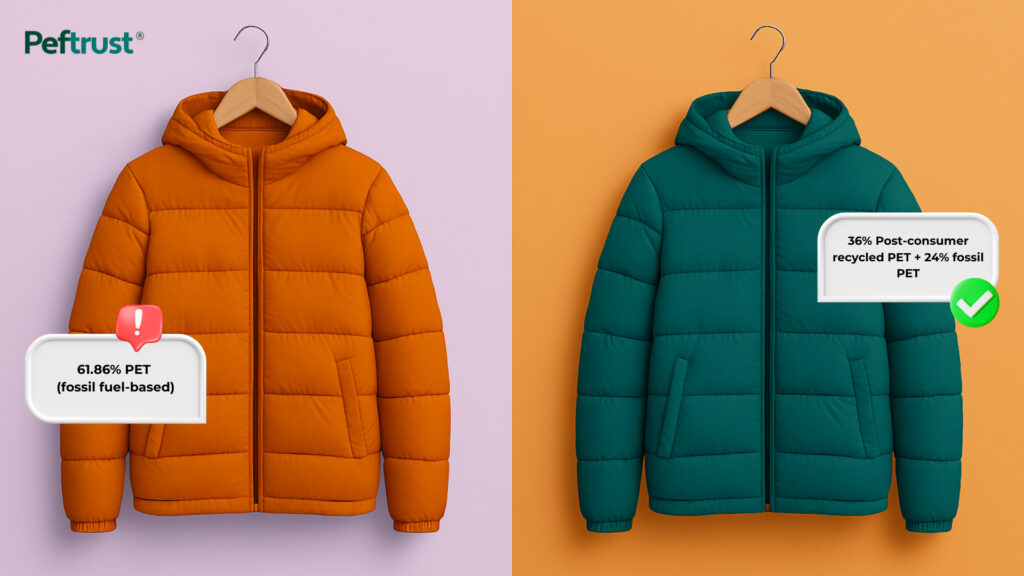
Ecodesign focuses on minimising environmental impact throughout a product’s lifecycle. Our platform helps companies integrate eco-friendly materials, enhance durability, and implement energy-efficient processes. To illustrate the power of ecodesign, we examined a case study involving the redesign of a jacket, which demonstrated notable improvements in sustainability profile:
Component
Original Material
Eco-Designed Material
Sustainability Rationale
Outer Shell
61.86% PET (fossil-based)
36% Post-consumer recycled PET + 24% fossil PET
Reduces carbon emissions and fossil resource use by replacing virgin PET with recycled inputs while maintaining performance
Padding
25.77% Virgin polyester wadding
21.25% Chemically recycled PET + 3.75% Recycled wool
Blending in natural recycled fiber reduces fossil use, supports circularity, and improves thermal regulation.
Lining
10.31% Nylon 6 (fossil-based)
10% Recycled nylon
Recycled nylon cuts environmental toxicity and fossil resource depletion
Trims
2.06% PVC (fossil-based)
3% Bio-based PE (e.g. sugar beet origin)
Switch to bio-based plastic reduces non-renewable input and improves circularity potential.
Replacing PFC-based water repellents improves environmental and human health impacts, especially in wet weather gear.
Key Impact Gains with Eco-Design
* ↓ 5% overall PEF score reduction
* Notable reductions in climate, resource depletion, and environmental health categories
* Strategic material swaps improve traceability, circularity, and compliance readiness (e.g. DPP, PEFCR)
Why 5% Matters
It might sound small — but apply this across a full collection with thousands of units, and the impact compounds dramatically.
One improved jacket → less carbon, less waste, better materials.
A hundred? A thousand? That’s where the future of scalable, sustainable design begins
Further improvements could be achieved by altering energy mixes, transportation modes, dyes, etc.
This example demonstrates how targeted material substitutions yield significant environmental improvements without compromising product quality.
Scaling Ecodesign with Peftrust Platform
The Peftrust ecodesign platform provides a comprehensive toolkit for sustainability improvement:
* See the full picture Track your product’s environmental performance across key categories in intuitive views from products to full collections
* Comparative analysis library Facilitates detailed comparisons between product designs, materials, and energy mixes to identify ROIs and align budgetary and sustainable targets
* Scenario modelling Enables testing of different design approaches in real-time to maximise impact reduction before anything goes to production
* Material impact assessment Quantifies how material changes affect environmental performance
* Comprehensive database precision Leverages our secondary database of over 5,500 environmental datasets and tools to help map your primary data faster
Why Database Precision Matters: The Peftrust Advantage
When sourcing a tool for eco-design comparison, it’s crucial to ensure that the underlying database is comprehensive and reliable. A robust platform should provide a diverse dataset across materials—offering the depth necessary for accurate and meaningful comparisons, even when primary data is limited.
Peftrust stands out by combining a robust and evolving library of high-quality secondary data, your primary data and verified supplier or manufacturer-level inputs, enhancing the precision of each assessment.
This combination enhances the precision and provides tools that enable you to pinpoint areas for improvement and ensure that your assessments are informed, consistent, and credible, ultimately leading to more effective ecodesign decisions.
This robust foundation enables:
* More relevant impact assessments across product categories
* Accurate scenario-building and alternative modelling
* Informed decision-making aligned with sustainability goals and regulatory requirements
How Peftrust Supports Your Sustainability Journey
Whether you’re beginning your sustainability journey or scaling across multiple product lines, our tools make environmental improvement both seamless and impactful. Peftrust helps brands navigate the evolving ecodesign landscape with confidence by aligning with the following:
– European PEF methodology The EU’s standardised environmental footprint calculation approach
– PEFCR Apparel and Footwear standards Industry-specific environmental assessment guidelines
– ISO 14026 communication principles International standards for environmental claims
AFNOR certification (the French standardisation association) has again validated our implementation of the Environmental Footprint Methodology. This third-party verification confirms our dedication to providing regulation-ready impact assessments for apparel & footwear. This gives brands the confidence that their results are credible, communicable, and audit-ready.
Take the Next Step in Your Ecodesign Journey
We invite you to experience how Peftrust can transform your approach to sustainable product design.
Sustainability Leaders play a crucial role in guiding organisations towards environmental responsibility, with a key focus on reducing supply chain emissions.
However, achieving meaningful sustainability outcomes requires accurate and reliable data.
The key to this achievement lies in collecting and utilising primary data.
Before delving into its significance, it is essential to define the three categories of data:
* Primary data: data collected directly from suppliers, manufacturers, or business operations.
* Secondary data: data derived from industry-average/third-party sources, incl. existing environmental databases & reports.
* Tertiary data: aggregated data from secondary sources, often used for broad market insights but lacks specificity.
The Significance of Primary Data for Sustainability Leaders
1/ Distinction Between Primary and Secondary Data
Primary data offers real-time, untainted, and specific insights essential for precise carbon footprint assessments (not just on CO2, but across all PEF environmental impact indicators like water, land, resource use, etc).
It enables brands to have visibility of their production ecosystem and allowing Sustainability Leads to identify and address emission hotspots to formulate targeted reduction strategies.
In contrast, secondary data relies on generalised industry averages, which may obscure critical areas for potential emissions reductions.
2/ The Impact of Primary Data on CO₂ Emission Reductions
Industry research underscores the efficacy of primary data in reducing carbon footprints. A study from McKinsey and MIT Climate Grand Challenges found that transitioning from secondary to primary data led to a 20% to 45% reduction in carbon emissions within the textile industry.
For instance, Unilever effectively integrates primary data into its supply chain management, enabling precise emissions tracking and targeted sustainability initiatives (World Economic Forum).
In a recent communication with Jessica Cederberg, a sustainability coach and founder of JCW Kommunikation, she highlighted the significant impact of primary data in shaping sustainability strategies to reduce emissions.
With more than 30 years of global experience in sustainability and business development, Jessica has collaborated with international brands to incorporate sustainability as a strategic advantage. She shared valuable insights regarding the importance of primary data in reducing carbon emissions.
“Studies and industry examples indicate that companies shifting to primary data collection from suppliers have observed emission reductions.
Primary data offers accurate insights into specific environmental impacts at each stage of the supply chain, allowing brands to better address high-impact areas like raw material sourcing, production, and transportation.”
Jessica Cederberg
3/ The Risks of Relying on Secondary Data
A lack of primary data may lead organisations to overlook significant sources of emissions, undermining the accuracy of reporting and the effectiveness of sustainability strategies.
An overreliance on secondary data may result in “carbon tunnel vision,” causing organisations to neglect broader environmental impacts, such as water usage, biodiversity, and circularity.
That said, secondary data still plays an important role in filling data gaps when primary data is unavailable. To maximise reliability, organisations should use tools like Peftrust’s Data Precision Ratio, which helps:
* Evaluate the influence of each data point on environmental scores
* Identify critical areas where primary data is essential
* Understand how missing data affects assessments and where default values may reduce accuracy
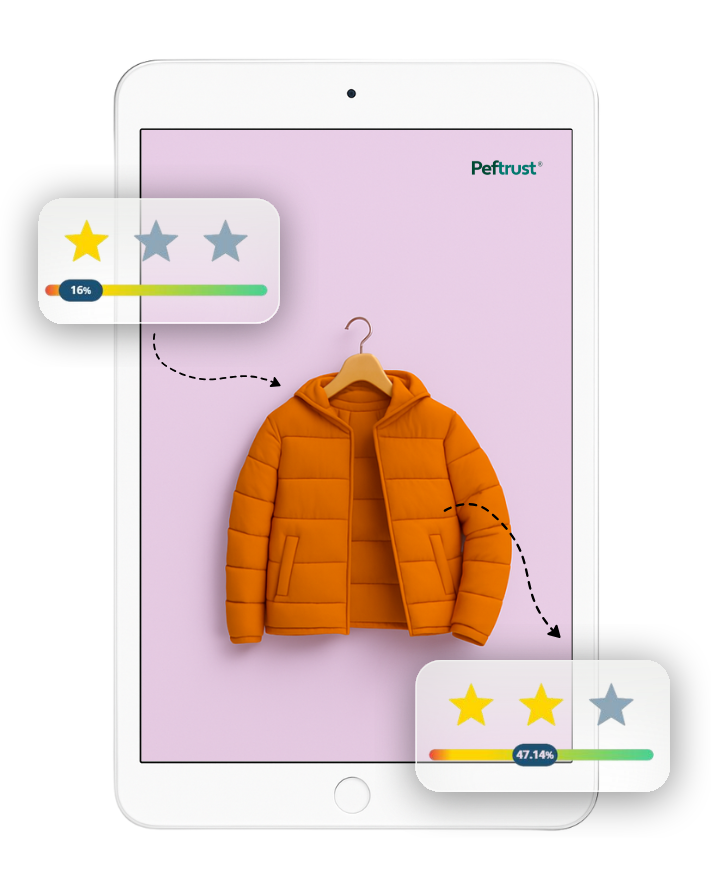
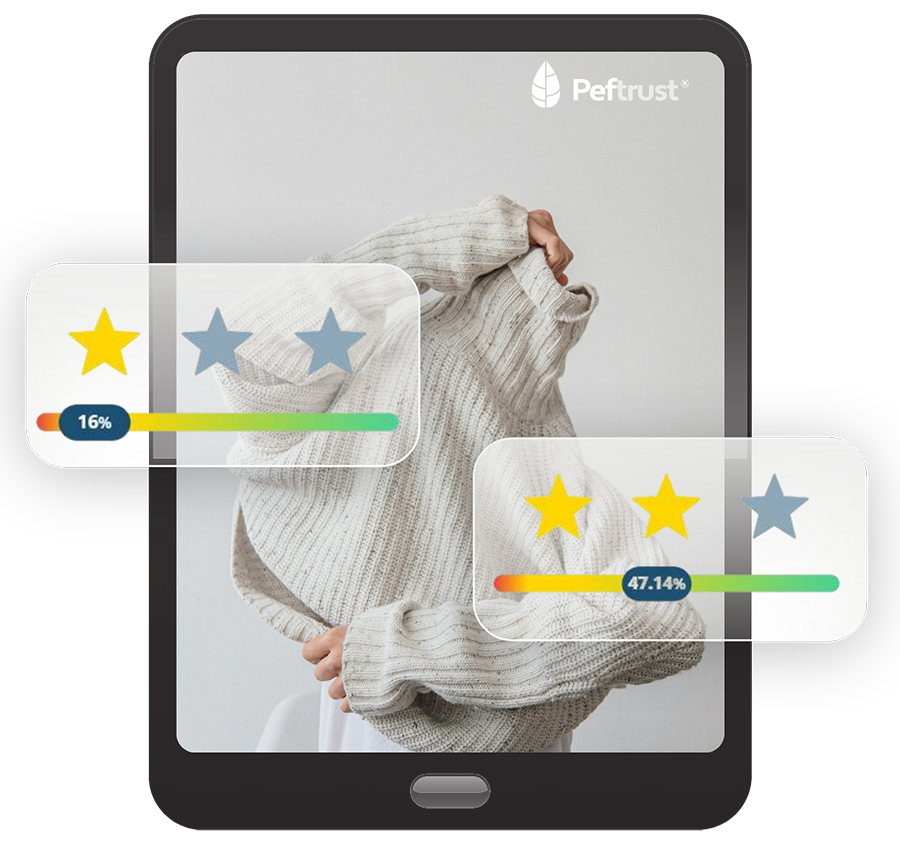
The Peftrust Data Precision Ratio (DPR) tool helps brands assess how primary vs. default data impacts their PEF and French eco-scores.
It highlights critical data points, shows where missing data lowers precision, and optimises resource allocation for better transparency.
🌟 Why the Stars? The star ratings indicate data accuracy levels by helping brands prioritise key primary data, pinpoint missing data’s impact, and optimise eco-scores
This allow brands to identify critical primary data points, assess how missing data affects final evaluations and understand where default values may lead to reduced precision. Jessica articulates this perspective as:
“Data isn’t just about looking back at past emissions; it’s about looking forward to anticipate where changes can be made for future impact”
Six Essential Steps for Effective Primary Data Collection and Utilisation
1/ Engagement with Internal Stakeholders
Sustainability is not confined to a single area – collaboration across various departments is imperative. Aligning sustainability objectives with internal teams in areas such as procurement, logistics, and operations ensures that primary data is seamlessly integrated into existing systems such as PLM (Product Lifecycle Management) and ERP (Enterprise Resource Planning).
By actively engaging internal stakeholders, organisations can break silos, build a data-driven structure, and accelerate sustainability efforts. For instance, hosting training sessions, workshops, and discussions can ensure that employees understand the importance of primary data and how it influences compliance and carbon footprint reduction.
2/ Mapping the Supply Chain
At the heart of supply chain mapping is collecting primary data from suppliers. This involves suppliers declaring the networks they work with and source from, including subcontractors, raw material sources, and manufacturing sites. The aim is to obtain timely, accurate and comprehensive information that can be verified using transactional documents. Primary data collection is necessary to understand the specifics of the supply chain. In this regard, Jessica emphasises a pivotal shift:
“As the power dynamics shift, it’s crucial to recognise that your suppliers hold the key to data—this is no longer just a “nice-to-have” but a “must-have” for your company’s sustainability journey.”
3/ Collaborate with Suppliers
A comprehensive understanding of the supply chain, encompassing Tier 1 and deeper suppliers, is crucial. Identifying suppliers possessing sustainability certifications or advanced data systems fosters enhanced data accuracy.
It is essential to work collaboratively with suppliers to emphasise the importance of emissions data. Organisations and suppliers should work on shared goals, providing support and guidance to help suppliers improve data accuracy and explore low-impact solutions together. According to Jessica:
“The shift in power means suppliers will need to share data now, and this will directly affect their relationship with your business. It’s no longer just about data collection but fostering a mutual commitment to sustainability goals.”
4/ Implementation of Data Collection Tools
To streamline data accuracy, businesses should invest in digital platforms. Adopting digital platforms that which aid in centralising and automating the data collection process helps organisations structure their data collection. These tools can integrate directly with suppliers and traceability platforms or with internal systems (PLM, ERP), ensuring consistency and accuracy.
Beyond data collection, advanced impact calculation tools, can effectively support businesses in data mapping, enabling them to improve their sustainability performance. This should include validating data quality through consistency checks on primary data and precision assessments.
An effective data strategy should include tools which aid users in refining the depth of their data, validate inputs, and align with specific organisational objectives, thus optimising their data collection efforts.
5/ Analyse and Act on the Data
Once collected, primary data should be leveraged to identify high-emission hotspots in production. Sustainability leaders must interpret insights, identify key trends, and implement data-driven strategies to enhance environmental performance.
Analysis of primary data enables organisations to prioritise sustainable materials, optimise transportation logistics, and execute targeted measures for reducing their environmental footprints, for instance, switching to low-impact raw materials, using low-carbon transportation, and durability testings.
6/ Ecodesign Progress Monitoring and Transparent Reporting
Establishing Key Performance Indicators (KPIs) aligned with ecodesign principles and science-based targets is crucial for compliance with evolving regulations, such as the Corporate Sustainability Reporting Directive (CSRD).
Product and Sustainability teams often operate in silos – one approaching challenges top-down, the other bottom-up – each with its own timelines, KPIs, and strategies for sustainable production. Eco-design, powered by primary data, bridges this gap. By integrating real-time, product-specific insights with a strong secondary database, companies can:
* Ensure accurate sustainability assessments
* Track material efficiency and reduce waste
* Measure real progress in lowering environmental impact
Regular assessments ensure data accuracy, track material efficiency, and highlight progress in reducing environmental impact. By integrating ecodesign into monitoring frameworks, organisations can move beyond product-level insights to assess the full sustainability footprint of their operations, fostering transparency and continuous improvement in circularity, resource optimisation, and lifecycle impact reduction.
Conclusion
Incorporating primary data into sustainability strategies is no longer optional. It is essential for accurate emissions tracking, regulatory compliance, and long-term environmental responsibility. Continuing the shift from secondary to primary data is a big leap.
Peftrust is here to support organisations so they can pinpoint emission hotspots, optimise supply chains, and drive meaningful carbon emission reductions. Moreover, collaborating with suppliers, leveraging digital tools, ensures transparency and accountability.
Sustainability Leaders must act now and start understanding what kind of primary data they should be collecting as weightening plays a huge role, at the same time, integrating an effective data collection framework can enhance their emission reduction performance.
Jumpstart any sustainability journey with our step-by-step guide — an essential read for professionals in product sustainability, whether affiliated with apparel, footwear, or home brands.
Product environmental performance, eco-score calculation, compliance and transparency are all part of your current challenges: book your 30-minute meeting to discover the Peftrust® 360° platform.
What challenges are brands facing? What are the solutions for making collections sustainable? How can brands and consumers act in favor of sustainability? Discover the answers in this article.