



For outdoor brands, where durability, technical performance, and environmental responsibility converge, understanding PEF is increasingly essential. This article addresses practical questions based on real-world experience working with apparel, footwear, and outdoor brands on product-level environmental assessments.
Building a Solid Foundation for Environmental Transparency
PEF is not about achieving the best score or crafting the cleanest sustainability story. It is about building a solid foundation, one that includes full life cycle assessment, durability modelling, and use phase impacts, one that uses shared rules and databases so results hold together under scrutiny.
For outdoor brands, this foundation is particularly valuable. Products built to last can demonstrate genuine environmental advantages. Repair programmes and quality construction become quantifiable benefits. The values the outdoor industry has long championed, respect for nature, durability, and production, can be substantiated with credible, comparable data.
In practice, the questions brands ask are specific: What is PEF actually useful for today? Where does comparison work, and where do expectations go wrong? Can primary data be used, or is everything locked to defaults? And how do durability and lifetime really affect results? The sections that follow address each of these directly.
What Is PEF and How Does It Work?
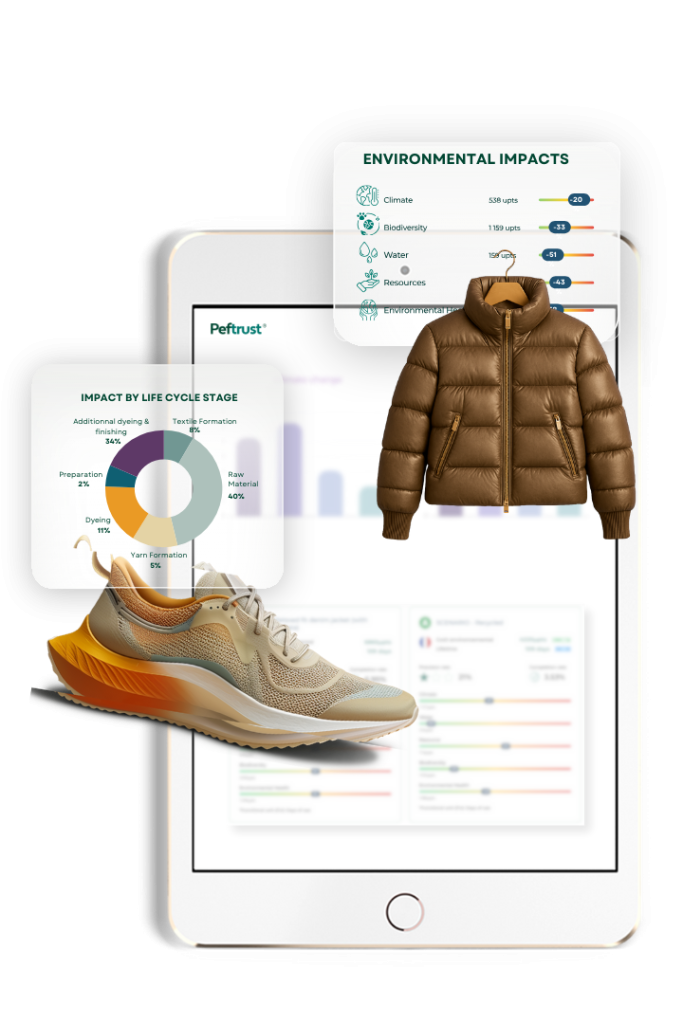
PEF is a life cycle assessment (LCA) methodology that measures environmental impact from raw material extraction through manufacturing, distribution, use, and end of life. Unlike simplified carbon footprinting, PEF covers sixteen impact categories, including climate change, water use, biodiversity, resource depletion, and ecotoxicity.
The framework succeeds because it addresses three challenges simultaneously: scope, impact coverage, and modelling rules. When brands compare different LCA studies and find wildly different results, it is usually because one of these elements varies between methodologies. PEF standardises all three, creating a common foundation for meaningful comparison.
This standardisation does not eliminate methodological debate, especially on contested materials such as wool or bio-based synthetics. What PEF does is move debates into a defined framework where assumptions become explicit and consistent rather than implicit and scattered. The debates become more visible, which is precisely the point.
Product Environmental Footprint Category Rules (PEFCRs)
PEFCRs define how specific product categories should be assessed. For apparel and footwear, these rules ensure valid comparisons: jackets compared to jackets, boots compared to boots. This category-specific approach prevents misleading comparisons between fundamentally different product types.
The rules also specify which data sources are acceptable, how to handle data gaps, and what default values apply when primary data is unavailable. This consistency is what makes PEF results comparable across brands and products.
Why PEF Matters for Outdoor Brands
Outdoor products present unique challenges for environmental assessment. Technical garments and footwear involve complex material combinations, including membranes, treatments, reinforcements, and hardware, that simpler methodologies struggle to capture accurately. A single jacket might include a dozen different materials, each with distinct environmental profiles.
PEF handles this complexity without oversimplifying. Under the PEF methodology, product complexity stays visible rather than being smoothed out. More materials and components mean more data to model. When specific data is unavailable, conservative default values provide a consistent foundation and set the stage for assessment, ensuring results remain comparable while data quality improves over time.
More importantly, PEF models product lifetime and use phase, which matters enormously for outdoor brands where durability is a core value proposition. Washing frequency, maintenance requirements, and expected product lifespan all factor into the assessment.
Durability Becomes a Measurable Advantage
PEF is a weight-based methodology, meaning material mass directly influences the score. However, a heavier product can still score better than a lighter alternative if it lasts longer and replaces multiple products over time. This is not marketing spin. It is how the methodology accounts for durability. When a product lasts twice as long, its environmental burden spreads across twice as many uses.
For outdoor brands built on quality and longevity, this represents a significant opportunity. Repair programmes, durable construction, and longevity design become quantifiable environmental benefits rather than just brand positioning.
Key Benefits of PEF for Sustainability Teams
Data Driven Eco Design Decisions
When disaggregated default data is available, PEF can help build scenarios where environmental impact concentrates within a product’s lifecycle. If raw materials dominate, often accounting for 40% of total impact, material selection becomes the priority. If dyeing and finishing contribute significantly, process innovation matters most.
Design teams can model alternatives before committing to production. What happens with recycled polyester versus virgin polyester? How does a different membrane affect the overall footprint? PEF can help provide quantified answers that inform real decisions.
Product Level Scope 3 Insights
For brands working on corporate emissions accounting, PEF provides the product-level granularity that Scope 3 reporting requires. The full life cycle approach captures upstream and downstream impacts, helping identify which products and categories contribute most to corporate footprint.
Regulatory Readiness
EU policy increasingly references PEF methodology. The Green Claims Directive, Digital Product Passport requirements, and Ecodesign for Sustainable Products Regulation are all leaning towards an alignment with PEF-based approaches. Brands that build PEF capability now are better prepared to apply consistent, product-level LCAs across eco-design, Scope 3 analysis, and future disclosure needs, without having to rework their foundations later.
Understanding the Limitations of PEF
Using PEF effectively requires understanding what it is designed to do, and what it is not.
PEF was not built as a standalone consumer message. It is a technical methodology designed to produce consistent, comparable product-level results across multiple impact categories. For this reason, PEF is most often used as the backbone behind consumer-facing labels or scores, rather than communicated directly. The French environmental display score is a good example of how PEF-based results can be translated into a format that is accessible to consumers.
Data gaps remain, particularly for innovative materials and novel processes common in technical outdoor products. Where gaps exist, conservative defaults apply, which may not fairly represent products that genuinely perform better. The good news is this gap is starting to close as more upstream material producers and process owners can now provide primary datasets, but collecting, validating, and maintaining that data at scale still takes real time and effort.
PEF is a technical methodology, but most of the complexity sits in the rules and calculations themselves. In practice, platforms handle this automatically, allowing teams to focus on understanding the results and using them to inform eco-design, sourcing, and product decisions. The learning curve is real, but it is manageable, and brands do not need to become LCA experts to benefit from the framework.
How to Get Started with PEF
For most brands, PEF works best when approached progressively rather than all at once.
- Start with strategic products. Begin with high-volume items, flagship products, or those under stakeholder scrutiny. Working on a focused scope makes internal capability manageable while delivering immediate value.
- Build data infrastructure progressively. Start with EF or PEF-compliant databases for defaults, then replace them with primary data for impactful areas, typically materials and key processing stages. Supply chain clarity can become increasingly visible as data maturity develops.
- Connect to business processes. The most successful implementations integrate footprint datainto design reviews, material selection criteria, and supplier evaluation frameworks. When PEF results inform decisions, the investment yields returns.
The Road Ahead
The journey from first assessment to mature capability takes time. Data gaps must be filled. Internal processes must adapt. Supply chains must be engaged. But the direction is clear: verified, standardised product environmental data will be increasingly expected by consumers, regulators, and stakeholders alike.
Brands that invest now position themselves ahead of regulatory requirements and competitive pressures. They reduce compliance risk, improve calculation accuracy, streamline supplier exchanges, and build the data infrastructure needed for Digital Product Passport requirements expected from 2027.
PEF offers a proven, structured, internationally recognised approach to meeting that expectation. For brands ready to move beyond approximate claims toward verified environmental performance, it provides exactly what its name promises: a solid foundation for understanding product environmental footprint.
