How Fashion Brands Turn Regulation into Competitive Advantage
Fashion brands are now expected to publish product-level environmental scores, often before their data systems are fully ready. In France, this means aligning with the Ecobalyse methodology, while at the EU level similar product transparency requirements are coming through the Digital Product Passport.
For many fashion teams, this requirement arrives before their supply chain data, traceability processes, and LCA workflows are fully in place.
This case study looks at how Kiabi approached that gap. Rather than waiting for perfect data or limiting the effort to a small pilot, Kiabi built an operational system that now supports environmental impact scoring across more than 7,500 products published on Ecobalyse.
The result is not just regulatory alignment, but a structure that can scale, improve over time, and support decisions beyond disclosure.
Why This Case Matters
Many fashion brands face the same practical constraints:
Supply chains spread across multiple tiers and regions
Supplier data that exists, but is uneven or hard to verify
Long onboarding cycles for traceability and digital tools
Difficulty turning traceability data into reliable LCA results
Under regulatory pressure, these issues often lead to rushed disclosures, heavy use of assumptions, or isolated pilots that never scale.
This case study shows what happens when a brand tackles those constraints directly. It documents how Kiabi moved from fragmented data to a working, repeatable system, using real operational inputs rather than one-off calculations.
What you will find in the whitepaper
This whitepaper is not a theoretical overview. It is a concrete account of how environmental impact scoring was deployed in practice, at scale, across a large fashion retailer.
Inside, you will see:
How traceability data feeds directly into LCA calculations and improves score accuracy
How responsibilities were structured between the brand, the traceability platform, and the impact calculation engine
What realistic timelines look like for supplier onboarding and data quality improvement
How data precision can improve progressively, without waiting for complete supplier coverage
How environmental impact data can be used internally for sourcing, eco-design, and decision-making, not just compliance
The focus is on execution: what worked, what took longer than expected, and what other brands should plan for if they want to avoid last-minute compliance.
Download the Environmental Impact Scoring Case Study for Fashion Brands
Access the full Kiabi–Peftrust–TextileGenesis case study and learn how environmental impact scoring can be deployed at scale in fashion.
The whitepaper is available in English and French.
“When the Digital Product Passport becomes mandatory, it will be a source of pride for us to meet it. We’re preparing for it — and we’re not afraid.”
As the fashion industry enters a transformative era of environmental accountability, the implementation of French Environmental Labelling is not only creating a clear divide between industry leaders and followers, but also reshaping the competitive landscape.
Latest Developments in French Environmental Labelling
The latest developments in this groundbreaking initiative aren’t merely about compliance. Instead, they represent an unprecedented opportunity for companies to demonstrate their commitment to sustainability while simultaneously gaining a competitive edge in an increasingly environmentally conscious market.
Specifically, early adopters of these enhanced environmental impact scoring standards not only meet regulatory requirements, but they also position themselves at the forefront of a global shift toward transparent, sustainable fashion.
Moreover, with consumers increasingly making purchasing decisions based on environmental credentials, mastering these new requirements could be the differentiator that sets your brand or products apart in 2025 and beyond.
This update provides critical information about developments in the Product Environmental Footprint (PEF) methodology as well as the latest changes in regulatory requirements. Notably it clarifies how the PEF methodology forms the basis for the French scoring system used in Affichage Environmental Labelling (Coût Environemental).
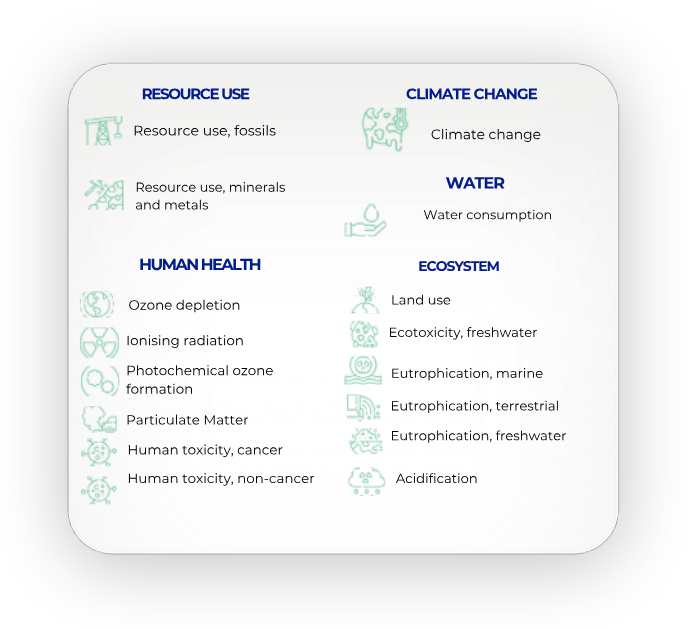
Both the PEF methodology and the French scoring system Coût Environnemental rely on the same dataset. However, they apply distinct methodologies to interpret the data and calculate scores. PEF provides a comprehensive lifecycle-based framework for apparel and footwear, utilizing 16 impact indicators in addition to Environmental Footprint (EF) weighting and normalization factors. Furthermore, it leverages a robust database of approximately 5,500 datasets and accounts for functional use (e.g., days of use) to derive its scores.
The 16 impact indicators
Even tough the French scoring system builds on PEF as a foundation yet tailors its methodology to meet local regulatory requirements. For instance, it focuses exclusively on apparel, excludes specific materials such as silk, leather, and cashmere, and uses a much smaller database (~82 datasets).
Additionally, it incorporates other elements not found in PEF, such as emotional durability, microfiber release, and pre-treatment and finishing impacts. Instead of directly accounting for functional use, the French scoring system uses durability multipliers and applies predefined scoring levels. Interestingly, Level-1 scores are always intentionally “reasonably worse” than Level-2.
Essentially, the French scoring system adapts PEF’s framework to fit its specific regulatory and practical needs, creating two different interpretations of the same dataset.
To sum it up, this update provides critical information about developments in Product Environmental Footprint (PEF) and the latest changes in regulatory requirements. For both newcomers and those already engaged with PEF for brands, understanding these updates is essential for successful environmental labelling compliance.
Recent Regulatory Progress
The French government has once again demonstrated its renewed commitment to the French Environmental Score “Cout Environnemental” through recent decisive actions. Notably, on November 28, 2024, the Minister for Ecological Transition, Agnès Pannier-Runacher, launched a public consultation on the implementation decree, marking a crucial milestone in this journey.
Meanwhile, Laurent Bocahut, our CEO at Peftrust, was honoured to attend and support this critical initiative, further emphasizing our company’s dedication to advancing sustainable practices in the fashion industry. The consultation period, which concluded on December 19, 2024, allowed stakeholders across the industry to contribute their insights and concerns.
Implementation Timeline
Note: This timeline reflects anticipated developments based on current industry insights and projections as of January 2025. As with any regulatory initiative, specific details, deadlines, and requirements are likely to evolve. Companies are encouraged to use this as a planning guide and stay connected with Peftrust for updates as the process unfolds.
January 2025: Submission of the Decree
– First and foremost, the environmental labelling decree will be submitted to the European Commission for review and feedback.
End of Q1 2025: Testing Phase Begins
– A year-long testing phase starts with producers (brands) to trial compliance measures.
– Gradually, the testing phase will expand to include distributors to ensure seamless implementation across the supply chain.
Initial Compliance (Q2-Q3 2025) – Phase 1
* Companies meeting turnover thresholds must complete mandatory registration.
* Implementation of data collection systems
* Additionally, integration with approved calculation platforms will be required.
* Staff training programs will be introduced to ensure regulatory expectations are met.
Full Implementation (Q4 2025) – Phase 2
* Mandatory environmental labeling for all clothing items
* Implementation of consumer-facing display requirements
* Integration with e-commerce platforms
* Establishment of verification procedures
Monitoring and Enforcement (2026 onwards) – Phase 3
* Regular audits will validate environmental claims and ensure compliance.
* Implementation of penalties for non-compliance
* Annual reporting requirements
* Continuous improvement for data quality, labelling and consumer engagement.
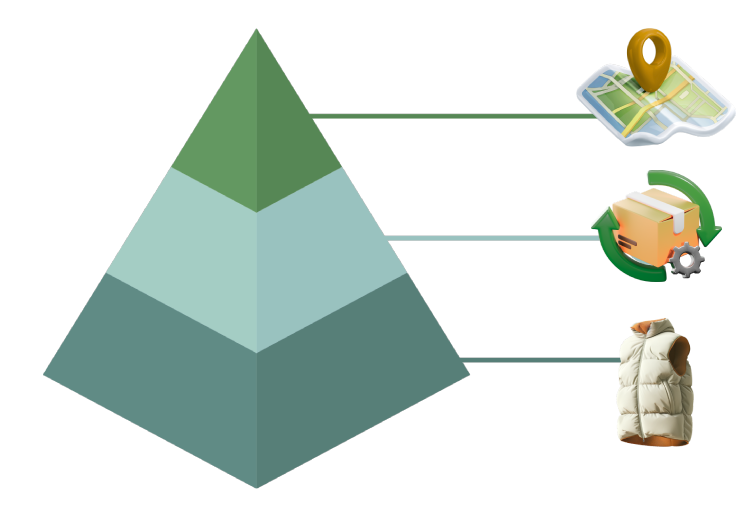
Understanding the Three-Tier Framework
In a nutshell, the French Environmental labelling system introduces a sophisticated three-tier framework that seamlessly combines accessibility and precision. Importantly, each tier builds upon the previous level’s foundation, allowing companies to progressively enhance their environmental assessment capabilities.
Foundation Assessment – Level 1
The entry point leverages the Ecobalyse platform, examining:
* Firstly, material composition analysis
* Secondly, Production location assessment
* Finally, basic manufacturing process evaluation
Advanced Evaluation – Level 2
This intermediate tier incorporates more detailed
Life Cycle Impact Assessment (LCIA) parameters, considering:
* For example, energy consumption patterns
* Water usage metrics
* Chemical input evaluation
* Transportation impact assessment
* Additionally, packaging lifecycle analysis
Comprehensive Analysis – Level 3
The highest tier provides the most detailed assessment through:
* Direct measurement systems
* Moreover, real-time monitoring
* Complete supply chain mapping
* Process optimisation analysis
* Finally, waste management evaluation
Peftrust’s Enhanced Support Services
Besides, since March 2024, Peftrust has been at the forefront of implementing the French Environmental Score, offering not only cutting-edge features but also enhanced capabilities that go beyond basic compliance. Thanks to our expertise in PEF for brands we provide comprehensive support across all assessment levels.
As a result, understanding and achieving Affichage environmental compliance becomes streamlined through our digital LCA platform, which integrates both the foundational PEF methodology and the specific requirements of the French system.
Next Steps for Businesses
To align with these updated requirements:
* First and foremost, review your current environmental assessment practices
* Next, evaluate which compliance tier matches your business needs
* Then, begin gathering the required documentation
* And finally, plan for system integration and staff training
Stay Connected
Join us to stay informed:
* Register for our upcoming March webinar
* Sign up for our newsletter for the latest updates on regulations and industry advancements
What challenges are brands facing? What are the solutions for making collections sustainable? How can brands and consumers act in favor of sustainability? Discover the answers in this article.


 Download the Environmental Impact Scoring Case Study for Fashion Brands